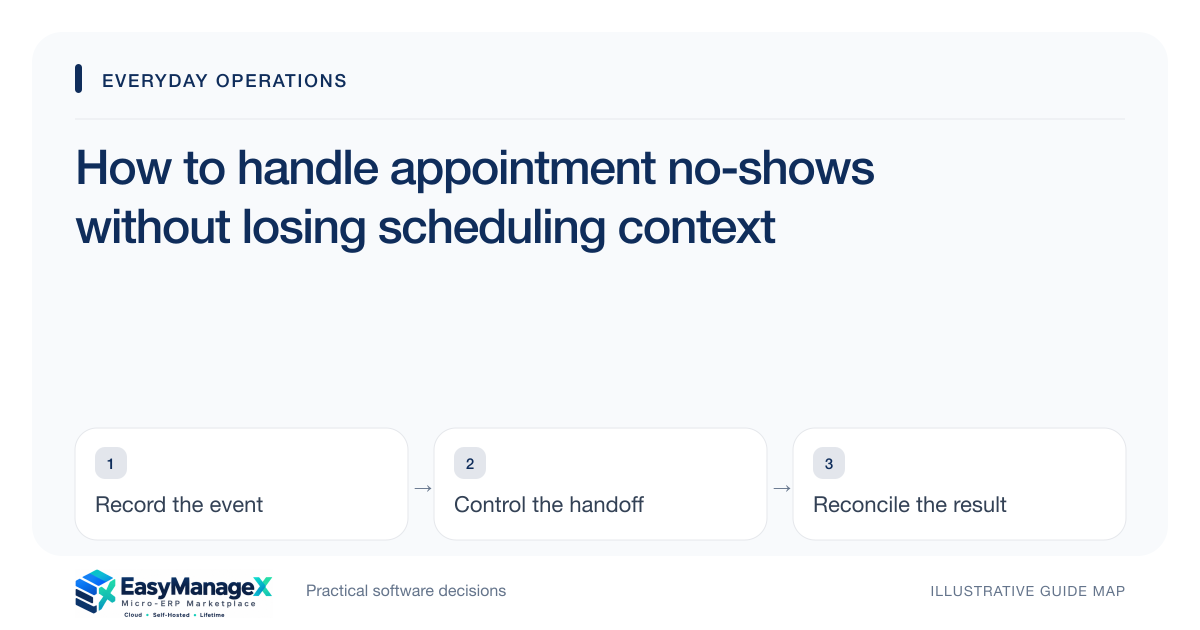
Handle appointment no-shows through a clear booking policy that distinguishes unconfirmed attendance, cancellation, late arrival and failure to attend. Record the relevant communication and resource impact, then assign a proportionate follow-up. Keep fees, credits and access decisions separate and governed by reviewed terms; a missed appointment should not automatically trigger an unexplained financial action.
- Distinguish no-show from cancellation and late arrival.
- Record attempted communication without assuming delivery.
- Assign follow-up and capacity-release decisions explicitly.
Define the attendance decision point
State when staff consider an appointment late and when they classify it as a no-show. Use service context: some appointments can begin late while others depend on a shared schedule. Publish the operational rule in terms staff and customers can understand.
Make the decision attributable. Record the booked time, observed arrival or absence and staff member responsible for the outcome. Avoid treating a blank check-in field as conclusive evidence when the reception process itself may have missed an arrival.
Separate confirmation from attendance
A customer can confirm and still fail to attend, while an unconfirmed customer may arrive. Keep these states separate. Confirmation is useful scheduling context but does not replace an actual arrival or service record.
Review communication failures explicitly. A reminder queued, sent or delivered can represent different evidence depending on the provider. Do not classify a customer as ignoring a message unless that conclusion is supported, and confirm provider behaviour during implementation evaluation.
Decide how capacity is released
Specify who decides whether the resource can be offered to a waiting customer or redirected to other work. Consider preparation already completed and the remaining service window. An empty calendar slot may still be too short for a replacement appointment.
Keep the original booking record and its outcome. If staff replace it with another customer’s appointment, retain the relationship or history needed to explain the schedule. Otherwise a later review can lose evidence of the missed commitment and the operational response.
Illustrative scenario: a missed training assessment
An illustrative training academy books an assessment requiring an instructor and a prepared room. The learner does not arrive within the academy’s defined window. Reception checks its arrival record, notes the contact attempt and records the outcome under the booking policy.
The instructor uses the remaining time for other work, while administration follows up about rescheduling. Any fee or credit question is reviewed under the accepted terms separately. The process explains the resource decision without implying that absence automatically authorises a charge.
Make follow-up useful and proportionate
Choose a follow-up purpose: confirm what happened, arrange a new appointment or explain the relevant booking policy. Assign an owner and date. Keep sensitive explanations out of broadly visible scheduling notes, using an appropriate record and access route when necessary.
Avoid permanent labels based on one event. Where repeated missed appointments affect scheduling decisions, define the review evidence and authority. Staff should understand the policy rather than inventing restrictions based on personal frustration or incomplete history.
Learn from patterns carefully
Review no-show records by service, channel and scheduling context using consistent definitions. Check missing arrival data or differing staff practices before attributing patterns to customers. A change in classification policy can alter the report without changing attendance behaviour.
Have scheduling staff review the sample outcome and explain how capacity, follow-up and any unresolved financial question are represented. Confirm actual reminder-provider evidence independently. Contractual fees or clinical consequences need appropriate review; an attendance status should record the operational event without silently deciding those other matters.
Your working checklist
- Define late and no-show decision windows.
- Verify arrival recording before classification.
- Distinguish confirmation and attendance states.
- Record communication attempts accurately.
- Assign capacity-release authority.
- Review follow-up under accepted terms.
Common questions
Should a missed appointment always incur a fee?+
That depends on reviewed terms and the applicable circumstances; this article does not determine the contractual or legal treatment. Keep the attendance outcome and financial decision separate. Staff should follow an accepted policy with appropriate authority rather than automatically charging because a calendar status changed.
How can a team avoid inaccurate no-show records?+
Check the arrival or check-in process before classifying absence, and define who makes the decision. Distinguish cancellation, late attendance and a genuinely missed appointment. Consistent definitions and retained evidence help prevent reception omissions or different staff practices from being misread as changes in customer behaviour.
Can reminders eliminate no-shows?+
Reminders can support communication, but they do not guarantee delivery, acknowledgement or attendance. Define how staff handle failed messages and unanswered confirmations. Evaluate the actual provider evidence and review attendance separately rather than assuming the existence of a reminders feature solves every missed appointment.
Sources and further reading
These primary references explain relevant concepts. Our scenarios and working checklists are original, illustrative guidance.
- IBM: What is enterprise resource planning?
Background on coordinating related operational records.
- OWASP Logging Cheat Sheet
Guidance relevant to distinguishing recorded events and attempted communications.
Published by EasyManageX as practical, AI-assisted guidance. Examples are illustrative. Confirm software capabilities, licence terms and project-specific requirements before committing. Read our editorial policy.