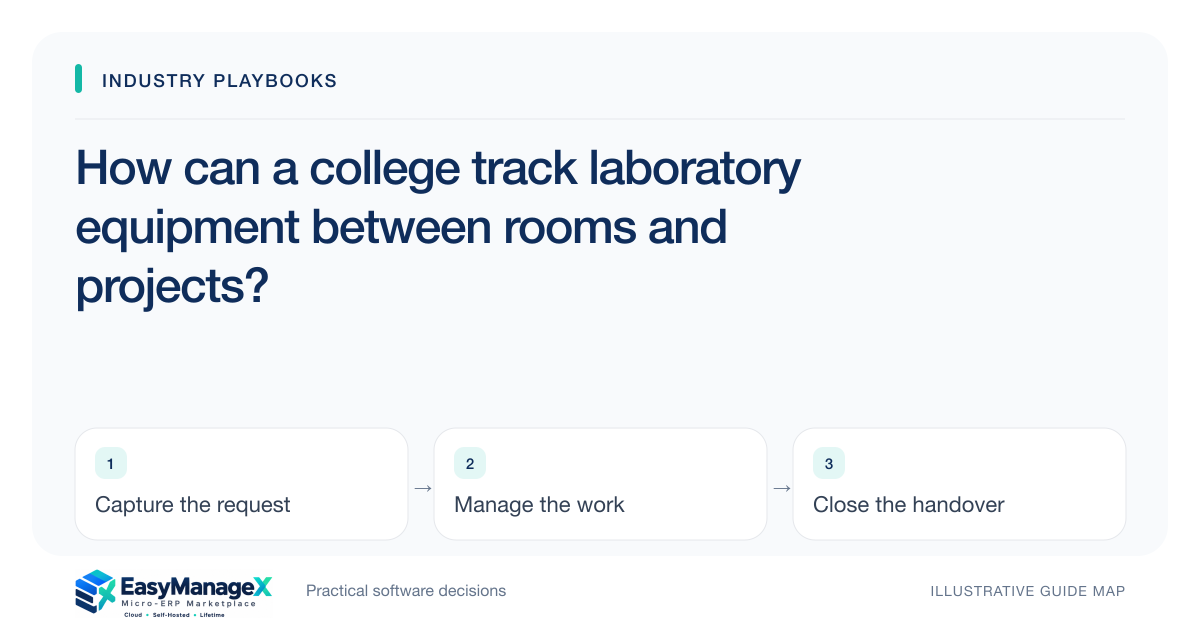
A college equipment register should identify each asset and record its current location, custodian and availability state. Link room transfers and project loans to explicit handovers, with condition observations at issue and return. Maintenance or missing-accessory cases should remain separate from ordinary availability so the next booking cannot promise equipment that is physically present but unusable.
- An asset’s location and custodian answer different questions.
- Record condition at issue and return.
- Exclude maintenance holds from bookable availability.
Begin with the equipment students actually borrow
Identify which laboratory items need individual tracking and which can be managed as quantities. A distinctive measuring instrument may need its own asset identifier, while routine consumables follow a different stock process. Mixing these models can make a simple loan list unnecessarily difficult to maintain.
Capture asset code, description, room, responsible department and relevant accessories. Use a label staff can read during a handover. Where existing identifiers are inconsistent, plan a supervised reconciliation rather than importing every spreadsheet row as a separate physical item.
Record custody alongside location
A room field says where equipment should be; a custodian field says who is responsible for the current handover. Keep both. A project loan may leave the asset inside the laboratory while transferring responsibility to a student team or supervising staff member.
Each movement should identify issuing person, receiving person, time and expected return or review date. Record a transfer when responsibility changes, even if the asset stays on the same shelf. That distinction helps staff investigate an overdue loan without assuming the room’s usual supervisor accepted it.
Separate condition from booking availability
Use clear availability states such as ready, reserved, issued and maintenance review. Condition notes support these states but should not be hidden in free text. A damaged accessory can make an otherwise functional instrument unsuitable for the next planned activity.
Maintenance decisions belong to the authorised technical owner. The administrative record can show the reported issue, inspection reference and hold status without prescribing technical procedures. Release the hold only after the responsible person records the appropriate decision under the college’s established process.
Illustrative scenario: a shared instrument changes hands
Consider an instrument booked for a student project and then requested by another laboratory. The current custodian confirms its return and the receiving laboratory checks the accessory list. Staff record the transfer rather than changing the room field without a handover.
A missing lead is discovered during the check, so the asset enters review instead of immediately becoming available for another booking. This illustrative scenario shows custody and availability decisions; it does not provide laboratory safety, calibration or technical operating instructions.
Review overdue and unconfirmed transfers
An overdue list should distinguish extended approved loans, missing return confirmations and assets reported elsewhere. Name a follow-up owner for each case. A student team’s project extension may explain an overdue date, but the extension still needs an authorised record.
Compare the register with physical observations at sensible intervals. When equipment is found in an unexpected room, record the discovery and reconciliation decision. Silently changing the location can conceal the fact that the intended custodian never acknowledged receiving the asset.
Evaluate using a real accessory bundle
Demonstrate an issue, a room transfer, a missing accessory and a maintenance hold. Ask whether booking users can see the resulting availability without access to unnecessary student details. Verify that the transfer history identifies the person who accepted responsibility.
EasyManageX product concepts are illustrative. Use your actual asset labels, room structure and loan rules in evaluation. Start with one shared equipment group, then expand after the laboratory team can complete handovers consistently during busy project and teaching periods.
Your working checklist
- Choose individually tracked assets and quantity stock separately.
- Reconcile existing asset identifiers.
- Maintain location and custodian fields.
- List accessories at issue and return.
- Define maintenance hold and release authority.
- Test an overdue loan and unconfirmed room transfer.
Common questions
Does a room change count as a custody transfer?+
Not always. Record location and responsibility separately so staff can see whether the same custodian moved an asset or another person accepted it. A clear handover acknowledgement is especially useful for shared equipment, where the room’s normal supervisor may not have participated in the move.
Should students see the full asset history?+
Give users the information necessary to request and return equipment, while limiting personal details and sensitive notes to appropriate staff. Verify permissions in booking, search and export views. Availability can usually be explained without exposing another student team’s unrelated administrative records.
Can the register decide when equipment is safe to use?+
It can record hold states and the authorised technical owner’s release decision. It should not replace laboratory procedures or qualified technical judgement. The operational goal is to prevent a booking from ignoring a recorded hold, not to infer safety from a status colour.
Sources and further reading
These primary references explain relevant concepts. Our scenarios and working checklists are original, illustrative guidance.
- Microsoft Learn: Inventory on-hand list
Further reading on inventory dimensions; relevant to distinguishing equipment identity, location and operational availability in a shared laboratory.
Published by EasyManageX as practical, AI-assisted guidance. Examples are illustrative. Confirm software capabilities, licence terms and project-specific requirements before committing. Read our editorial policy.