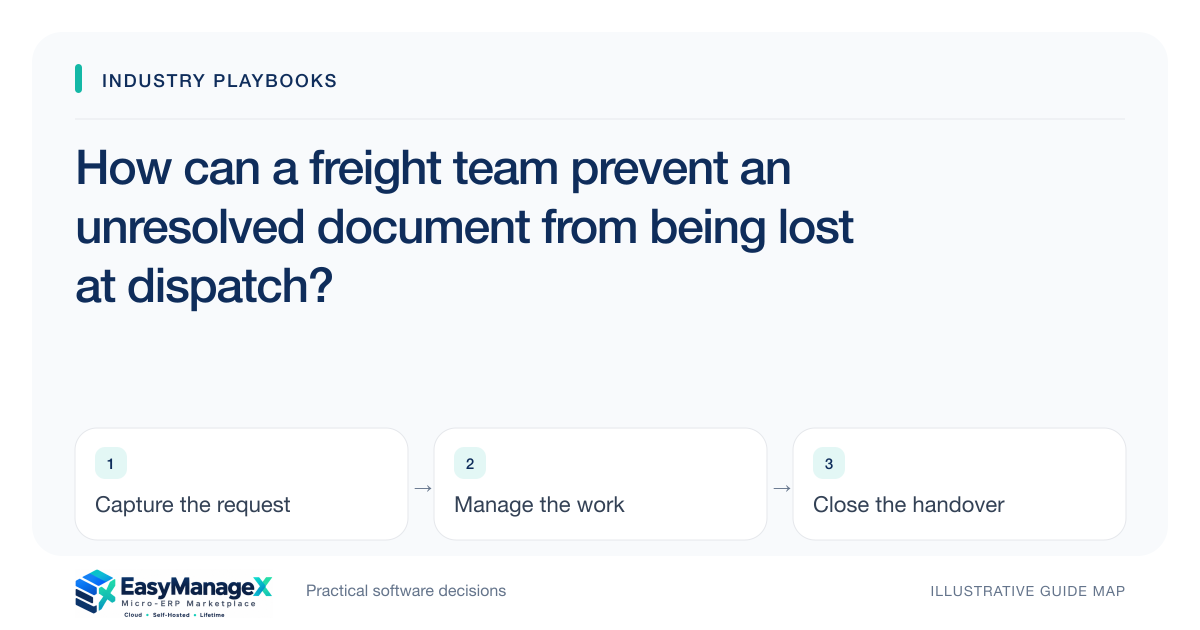
A freight team should maintain a shipment-linked document checklist with named reviewers, required references and current decision states. Keep received, reviewed and unresolved documents distinct, and show exceptions at the dispatch handoff. The register supports the team’s authorised procedures; it should not infer regulatory completeness or permission to move goods merely because an upload field contains a file.
- File receipt and authorised document review are separate.
- Use shipment references to connect versions and milestones.
- Dispatch needs an actionable exception owner.
List documents by the actual shipment workflow
Begin with the references and reviews your freight operation requires for its shipment types. Requirements may vary by route, customer arrangement or responsible provider. Record the applicable checklist and owner rather than assuming one document set fits every movement.
Use a stable shipment identifier across bookings, documents and dispatch milestones. If a provider supplies its own reference, retain the mapping. Staff need to identify which shipment a revised attachment concerns without relying on a filename that contains only a customer name.
Separate received files from reviewed outcomes
A received document should record source, version and time. Review is a separate authorised decision with its own state. An empty review field matters even when the document folder appears full, because the upload may be incomplete, outdated or awaiting clarification.
Technical and regulatory interpretation belongs to the operation’s appropriate qualified personnel and established procedures. The register can preserve their decision and supporting reference. It should not present an administrative checkbox as independent confirmation of compliance or a legal right to dispatch.
Make unresolved items visible at handover
An exception should name the missing or disputed reference, review owner and next action. Dispatch needs to know which authorised decision remains pending, not simply see a red document count. Include the expected follow-up time when the responsible reviewer can provide one.
If a replacement document arrives, retain its relation to the earlier version. The reviewer should identify which version supports the current decision. Silently overwriting the attachment can leave a dispatch team or external provider relying on a copy that the register no longer explains.
Illustrative scenario: a revised packing reference arrives
Consider a freight shipment whose packing reference is revised after the operational booking is created. The coordinator links the new version to the shipment and assigns the relevant review. The dispatch handoff shows the unresolved decision rather than treating file receipt as completion.
Once the authorised owner confirms the appropriate outcome, staff record the version reference and handoff acknowledgement. This illustrative scenario describes coordination and evidence management; it does not provide customs, legal or regulatory guidance for any route or shipment.
Review the milestone sequence after changes
A document change may require the team to review an earlier milestone or notify a provider. Record that next action explicitly instead of changing the shipment’s overall status and expecting others to infer the consequence. Preserve who acknowledged the revised instruction.
At closing, retain unresolved provider responses and the authoritative references supporting completed milestones. A shipment marked closed can still need a document follow-up. Distinguishing operational closure from outstanding administrative tasks prevents the record from losing its remaining owner.
Evaluate a replacement after review
Ask a demonstrator to receive a document, record review and then introduce a replacement before dispatch. Inspect the handoff view and its owner queue. The operator should identify the authoritative version and any required re-review without reading private messages.
EasyManageX listings are illustrative. Validate shipment links, version references and role permissions against your own checklist. Keep the evaluation focused on traceable handoffs, while qualified personnel determine the actual documents and approvals applicable to your freight operation.
Your working checklist
- Define shipment-specific document checklists with owners.
- Map internal and provider shipment references.
- Separate received and reviewed states.
- Link replacements to earlier versions.
- Expose unresolved decisions at dispatch handoff.
- Test a replacement received after review.
Common questions
Can a complete upload folder prove dispatch readiness?+
A folder can show that files were received, but readiness depends on the authorised reviews and procedures applicable to the shipment. Keep reviewed outcomes and unresolved questions visible. Do not substitute file presence for qualified regulatory, technical or contractual decisions.
What should happen when a document is replaced?+
Retain the earlier reference, link the replacement and assign any required review to its responsible owner. Record which version supports the current decision. Notify affected handoff participants according to the operation’s process, because an external copy may still reflect the previous instruction.
Should closed shipments hide document tasks?+
Keep remaining administrative tasks visible even when an operational milestone is complete. Use separate ownership for the outstanding response or correction. That allows staff to close completed work without implying that every linked document question has been resolved or erasing its follow-up responsibility.
Sources and further reading
These primary references explain relevant concepts. Our scenarios and working checklists are original, illustrative guidance.
- ERPNext documentation: Project
Further reading on linked milestones and task ownership; relevant to freight document follow-up without implying regulatory dispatch approval.
Published by EasyManageX as practical, AI-assisted guidance. Examples are illustrative. Confirm software capabilities, licence terms and project-specific requirements before committing. Read our editorial policy.