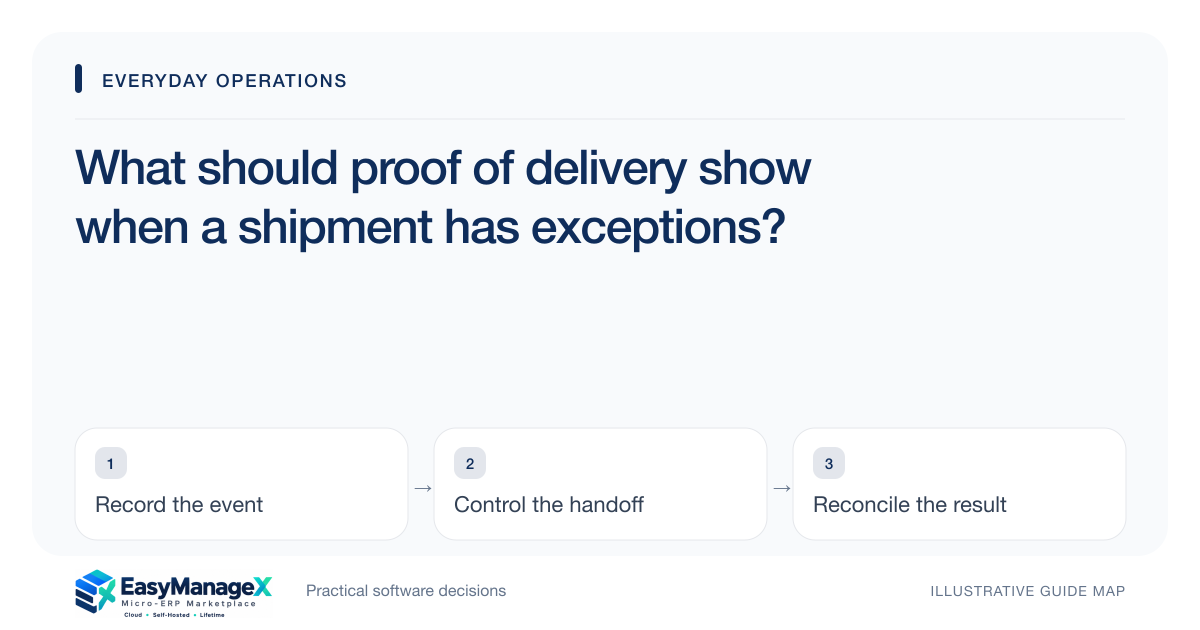
A courier delivery exception should describe what was observed, identify the shipment and assign the next decision to an owner. Keep attempted delivery, recipient acknowledgement and proof review as distinct events. Record only necessary contact and evidence details, and retain disputed or incomplete outcomes instead of forcing every route stop into a delivered or failed label.
- An attempt is different from recipient acknowledgement.
- Every unresolved stop needs a next action and owner.
- Limit proof records to necessary information.
Define shipment and stop references
Use a shipment identifier that connects the dispatch record, route stop and customer enquiry. If another carrier supplies a reference, retain it alongside the internal one. Staff should be able to locate the exception without searching by a partial address or an informal driver message.
A route stop may involve multiple shipments, so preserve item-level outcomes where needed. One successful handover should not automatically mark every parcel for that address complete. Record the affected quantity and shipment reference when the receiving person acknowledges only part of the bundle.
Describe the observed exception precisely
Use categories that lead to useful actions, such as unavailable recipient, address review, partial handover or disputed acknowledgement. Record the observation in plain language. Avoid conclusions about a person’s intent or a final commercial outcome that the field employee cannot establish.
Separate evidence captured in the field from the later review decision. A photograph, note or external event may support investigation without resolving the case alone. Define who can review the evidence and what information the next customer-service employee needs to act.
Protect contact and proof information
Collect only the contact and evidence details necessary for the delivery workflow. Apply appropriate role access and retention under the business’s established process. A shared exception list should not expose unrelated recipient details or personal information simply because every field employee can open it.
Keep sensitive information out of generic logs and broad exports wherever the process permits. Staff can usually follow up using the shipment reference, relevant contact channel and reason category. Review actual access from field and service accounts, including search results and downloadable reports.
Illustrative scenario: only one parcel is accepted
Imagine a stop containing two parcels where the recipient acknowledges one but asks for review of the other. The driver records the shipment-level outcomes and the necessary proof references. Customer service receives an assigned exception rather than a route status marking both parcels delivered.
The remaining parcel follows the authorised next action and custody record. This illustrative scenario concerns accurate handoffs and evidence ownership; it does not determine liability, contractual obligations or the legal meaning of a particular acknowledgement.
Give follow-up work a practical queue
Each open exception needs responsible person, next action and review time. Distinguish a case awaiting customer response from one awaiting an internal proof check. Without that distinction, staff may repeatedly contact a recipient while the actual unresolved work sits with another team.
Preserve corrections when evidence or identity was entered incorrectly. Link the corrected record to the original event and note the authorised reason. This allows customer service to explain the sequence without deleting a disputed delivery attempt or creating a second shipment history.
Evaluate partial and disputed outcomes
Demonstrate a partial stop, unavailable recipient and disputed acknowledgement. Ask how the next service employee locates the case and whether evidence remains appropriately restricted. Verify the custody state of the undelivered parcel after the route employee completes their stop.
EasyManageX product concepts are illustrative. Confirm field capture, shipment links and exception permissions using your actual identifiers. A clear pilot can be more valuable than a large proof dashboard if it establishes who must resolve the next action for each unresolved parcel.
Your working checklist
- Connect shipment, route and external references.
- Record outcomes at the required parcel level.
- Define observed exception categories.
- Restrict contact and proof information by role.
- Assign next actions and review times.
- Test a partial handover and disputed acknowledgement.
Common questions
Is a photograph enough to mark delivery complete?+
Use the authoritative evidence and decision requirements defined by your business process and agreements. A photograph can support a record without settling every question about identity, quantity or acknowledgement. Keep proof review separate where required and route disputed outcomes to the responsible person.
How should a partial stop appear?+
Preserve each affected shipment and its acknowledged quantity. The accepted parcel can have its recorded outcome while the remaining parcel retains an exception and custody state. Avoid a single address-level completion flag that obscures which goods actually changed hands at the stop.
Who should access delivery proof?+
Assign access according to the roles that need to capture, review or communicate the outcome. Field and service users may require different detail. Check search and export views as well as the main screen, and follow the business’s established privacy and retention procedures.
Sources and further reading
These primary references explain relevant concepts. Our scenarios and working checklists are original, illustrative guidance.
- OWASP Logging Cheat Sheet
Principles for meaningful event records and excluding sensitive information; relevant to delivery attempts, proof review and correction history.
Published by EasyManageX as practical, AI-assisted guidance. Examples are illustrative. Confirm software capabilities, licence terms and project-specific requirements before committing. Read our editorial policy.