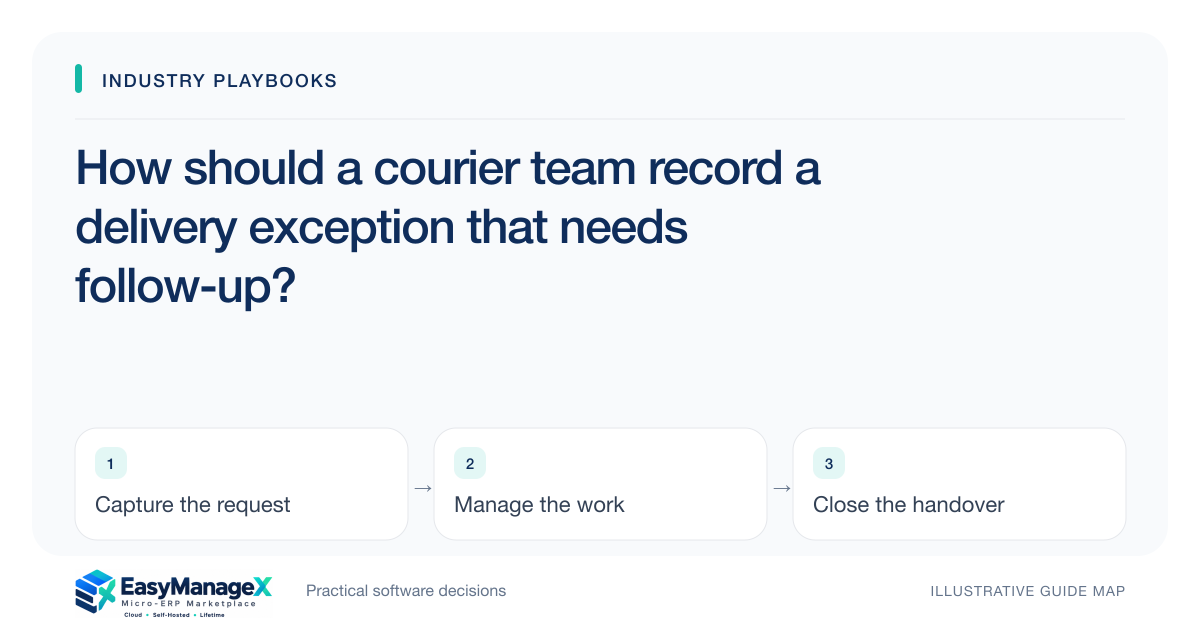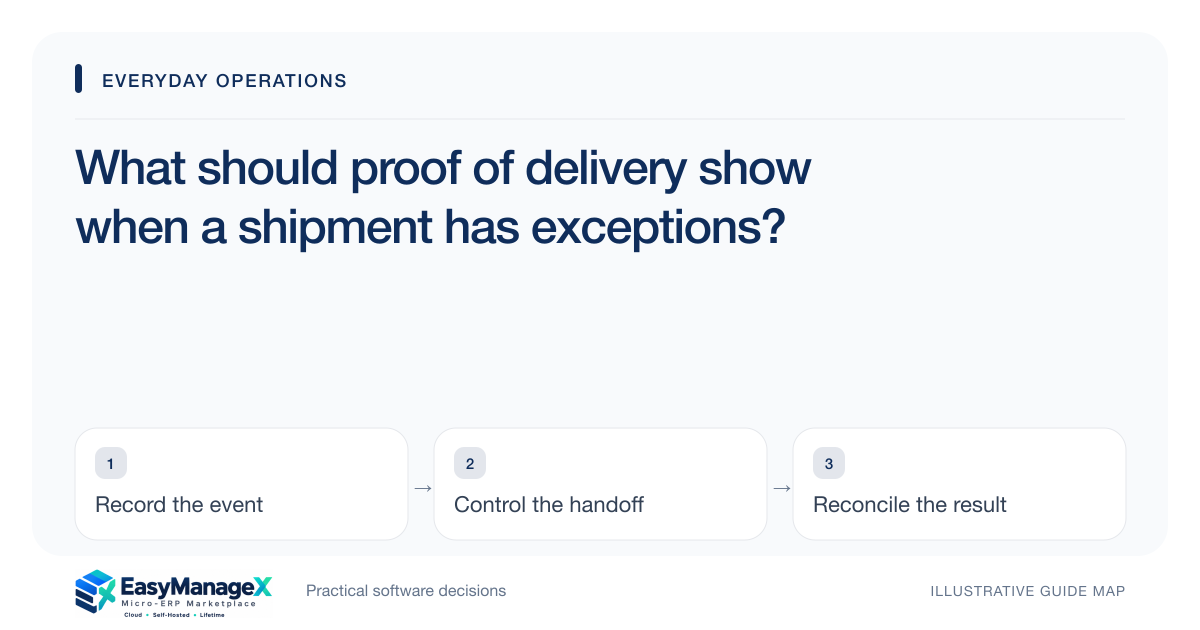
Proof of delivery should identify the shipment, delivery event, recipient or accepted verification method, quantities received and any exception. Define what evidence your business requires before completion. A photo, signature or carrier status can contribute context, but none automatically resolves damage, short receipt or delivery to an unintended location without review under your agreed process.
- Link evidence to a specific shipment and event.
- Record accepted quantities and exceptions separately.
- Assign a reviewer for disputed delivery outcomes.
Identify the event being evidenced
Use a shipment reference, order relationship, delivery time and relevant destination context. Evidence should explain which goods were delivered rather than merely show that a driver visited an address. Keep the delivery attempt separate when no handoff occurred.
Choose the verification method appropriate to the service and accepted terms. A named recipient, approved unattended-delivery process or another agreed method can require different evidence. Document that choice instead of assuming one generic signature requirement fits every delivery.
Record quantity and condition differences
A customer may accept only part of a shipment or report visible damage. Capture affected lines, quantities and the observed exception. Do not treat a signature as proof that every expected item arrived in acceptable condition when the record indicates otherwise.
Use clear exception reasons and supporting references. The person recording an observation should distinguish it from a final determination of responsibility. Commercial, contractual or legal conclusions may require further review beyond the operational delivery record.
Keep evidence proportionate and controlled
Collect only information needed to establish the delivery event and resolve likely questions. Photos or location data can reveal personal details unrelated to the shipment. Define authorised access, storage and retention appropriate to your process and obtain relevant professional guidance where needed.
Consider what happens when a device is offline or evidence upload fails. Staff need a documented fallback and reconciliation step. A completed mobile screen is not proof that the central record received the attachment, so evaluate those states separately.
Illustrative scenario: a partial equipment delivery
An illustrative equipment supplier delivers a shipment with three packages, but the recipient accepts two because the third is visibly damaged. The driver records the shipment reference, accepted packages and exception, then returns the damaged package through the defined custody process.
Customer service reviews the linked evidence and assigns resolution of the outstanding item. The order remains partially fulfilled. Marking the shipment delivered without the quantity distinction would obscure the remaining obligation and make the recipient’s later enquiry difficult to answer.
Design a dispute and correction route
A delivery dispute needs the original evidence, reported issue, owner and next review action. Preserve attachments and prior status changes where appropriate. Corrections should explain what changed rather than replacing the original event with a cleaner story.
Link the outcome to return, replacement or financial records when those actions occur. A resolved support ticket does not necessarily mean the replacement has been delivered or the refund completed. Keep each consequential action evidenced by its own record.
Evaluate the exception cases explicitly
Ask a candidate implementation to show a failed attempt, partial receipt, offline capture and disputed recipient. Check access to the evidence and whether exports retain usable shipment references. A proof-of-delivery feature label alone does not describe these behaviours.
Have dispatch and customer-service staff interpret the same partial-delivery record, including its failed-upload case. Confirm who may retrieve evidence and who resolves the outstanding item. The operational record should explain custody and quantities; appropriate professionals must assess any contractual or legal interpretation of the acknowledgement.
Your working checklist
- Define evidence for each delivery method.
- Use stable shipment references.
- Record accepted and disputed quantities.
- Set attachment access and retention rules.
- Document offline or failed-upload handling.
- Assign delivery-dispute review ownership.
Common questions
Is a delivery photo enough to close an order?+
Only if it satisfies the accepted evidence rule for that delivery and no unresolved quantity or condition issue remains. A photo may show location without proving the intended handoff or contents. Keep the evidence’s meaning explicit and refer contractual or legal interpretation to appropriate professional guidance.
How should a failed delivery attempt be recorded?+
Keep it as an attempt with time, reason, relevant evidence and the next action owner. Do not mark the goods received simply because the driver reached the destination. A new attempt, recipient contact or return decision should remain linked to the shipment so the fulfilment position is understandable.
What if delivery evidence was captured but not uploaded?+
Use the documented fallback and reconcile the local capture with the central record before treating the evidence as available. Preserve the shipment reference and record the upload exception. Candidate tools should demonstrate this distinction so staff do not confuse a device confirmation with successful storage of the evidence.
Sources and further reading
These primary references explain relevant concepts. Our scenarios and working checklists are original, illustrative guidance.
- OWASP Logging Cheat Sheet
Guidance on attributable event evidence and avoiding unnecessary sensitive content.
- OWASP Authorization Cheat Sheet
Guidance relevant to restricting retrieval of delivery attachments.
Published by EasyManageX as practical, AI-assisted guidance. Examples are illustrative. Confirm software capabilities, licence terms and project-specific requirements before committing. Read our editorial policy.