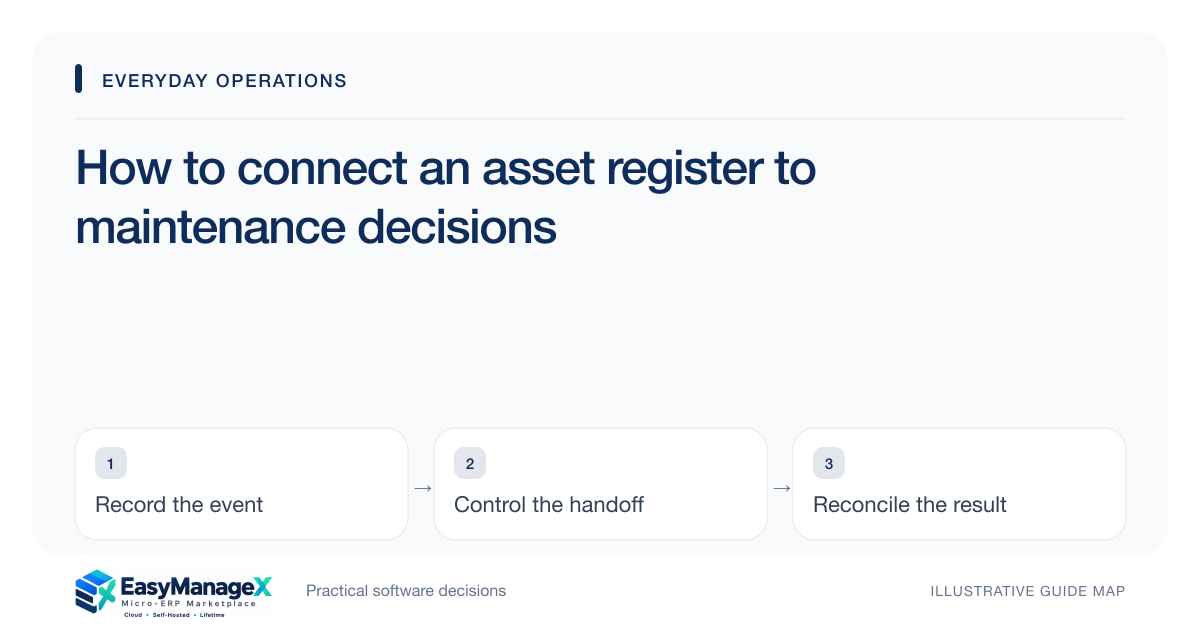
An asset register becomes useful when each identifiable asset connects to its location, responsible custodian, service history and next maintenance decision. Define what counts as an asset and how movements are recorded. Separate a scheduled service from evidence that work was completed, and record defects so replacement discussions can use the same operational history.
- Use an asset identifier that survives location changes.
- Distinguish scheduled service from verified completion.
- Record defects and custody transfers against the asset.
Choose the asset boundary
Decide whether the record represents one machine, a component, a kit or a pool of interchangeable items. The choice affects counting and service history. A tool kit with missing components needs a different record model from a single serialised machine.
Use a stable internal identifier and retain manufacturer identifiers where relevant. Names and locations can change. An identifier that depends only on a room or employee name makes it difficult to trace the same equipment after a transfer.
Make custody and location explicit
Record where the asset is expected to be and who is responsible for its operational care. A transfer should identify the sending and receiving parties, date and condition. This supports accountability without assuming the custodian personally caused every fault.
Keep unavailable states meaningful. An asset under repair, awaiting inspection or loaned elsewhere should not appear ready for use simply because it remains in the register. Define which transitions require a review before the asset returns to operational availability.
Design maintenance around the actual trigger
Maintenance can be triggered by time, usage, condition or a reported issue. Record the chosen trigger and the evidence needed to assess it. A monthly reminder is inappropriate when the important limit is operating hours that nobody records.
Name the person who reviews overdue work and decides the next action. Some tasks may require qualified personnel or manufacturer instructions. Follow those requirements rather than replacing technical judgment with a generic schedule or automatically extending due dates.
Illustrative scenario: a rental generator
An illustrative equipment-rental business tracks a generator by asset ID across several customer jobs. Return inspection notes an unusual noise and places it on hold. The next booking remains a demand, but the generator is no longer counted as available equipment.
A service technician records diagnosis and work performed, then an authorised reviewer accepts the return-to-use evidence. The history links the reported defect, service action and decision. A calendar reminder marked done would provide much less context for the next rental.
Capture service work and remaining limitations
A service record should identify the asset, task, date, responsible person, observations and supporting evidence. Keep parts or external service references where they help explain the work. A remaining limitation should be visible to the next operator or planner.
Define the completion reviewer according to the task’s significance. For simple housekeeping, the worker’s confirmation may suffice; for consequential repairs, another qualified review may be needed. The process should reflect the asset and task rather than a universal approval requirement.
Use history for repair and replacement review
Bring together repeated faults, downtime records, repair effort and operational constraints when reviewing replacement. Explain uncertainty in incomplete records rather than inventing a precise economic conclusion. Finance may apply separate accounting and depreciation policies with professional guidance.
Ask the asset custodian and maintenance reviewer to trace the sample defect through service and return-to-use evidence. Confirm what holds the asset unavailable and who releases it. Technical maintenance requirements and accounting treatment need their own qualified review rather than being inferred from an asset register demonstration.
Your working checklist
- Define each asset record boundary.
- Assign stable asset identifiers.
- Record custody and location changes.
- Choose time, usage or condition triggers.
- Specify return-to-use evidence.
- Review repeat faults with linked history.
Common questions
Should every small item have an individual asset record?+
Only when individual identity supports a useful decision such as custody, service, availability or replacement. Low-value interchangeable items may be better managed as a pool or inventory. Define the boundary deliberately so the register remains maintainable and does not demand detailed tracking without a practical purpose.
Is marking a maintenance task complete enough?+
The required evidence depends on the task. Record who performed it, when, what was observed and any unresolved limitation. Where technical qualification or a separate review is required, preserve that decision too. A completion flag alone may not explain whether the asset is ready for its next use.
Can asset software decide whether equipment is safe?+
Software can organise observations, schedules and review evidence, but it does not replace competent technical judgment or required inspections. Follow applicable manufacturer instructions and qualified guidance. Verify how candidate systems represent holds and authorisations without treating an available status as a certification of safety.
Sources and further reading
These primary references explain relevant concepts. Our scenarios and working checklists are original, illustrative guidance.
- ERPNext documentation: Quality Inspection
Further reading on recording checks and their acceptance evidence.
- OWASP Logging Cheat Sheet
Guidance relevant to attributable service and custody events.
Published by EasyManageX as practical, AI-assisted guidance. Examples are illustrative. Confirm software capabilities, licence terms and project-specific requirements before committing. Read our editorial policy.