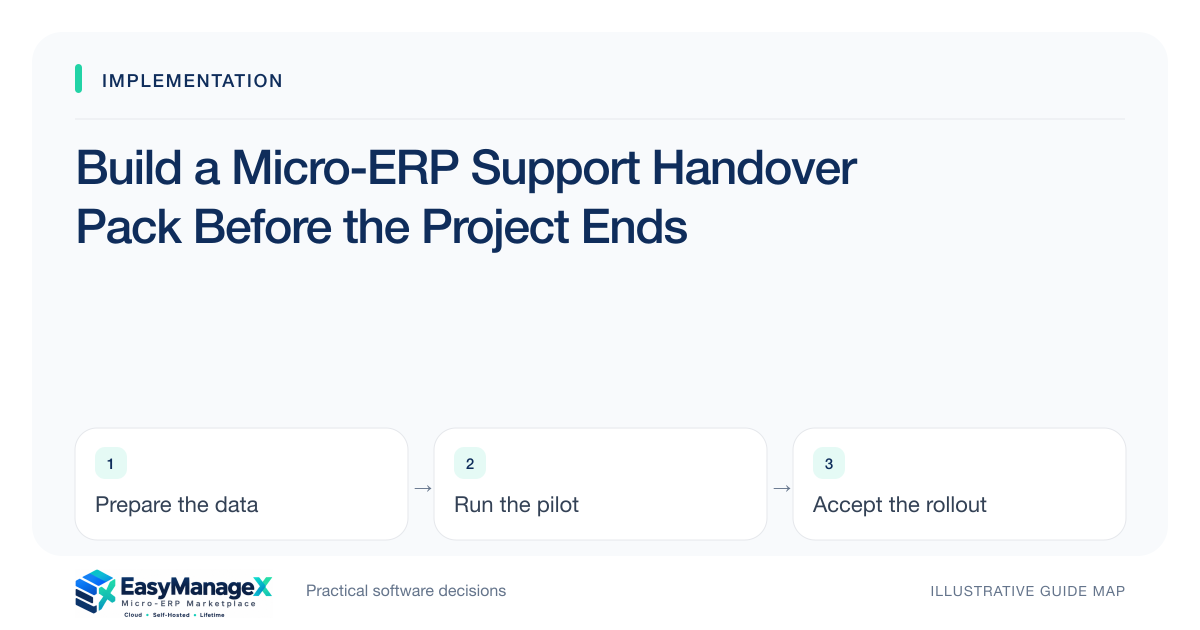
A support handover gives the operating team the information and authority to maintain the agreed workflow. Include owners, account administration, configuration, integrations, recovery references, known limitations and escalation routes. Verify that another qualified person can use the pack. Project completion should not leave routine operation dependent on undocumented knowledge held by the implementation team.
- Name owners for application, infrastructure and business decisions.
- Record unresolved limitations with accepted workarounds.
- Demonstrate that the operating team can use the handover.
Define who owns operation
List the process owner, administrator, hosting operator, integration maintainer and support contact. Some roles may be performed by one person or provider, but keep responsibilities distinct. The organization needs to know who decides, who executes and who coordinates when a problem crosses application and infrastructure boundaries.
Confirm absence cover and account ownership. Operational access should belong to the organization through approved arrangements, not rely on a project worker’s personal login. Store credentials and sensitive recovery information securely; the handover pack can reference approved storage without reproducing secrets in ordinary shared documents.
Record the implemented configuration
Include version, deployment description, important settings, role matrix and configuration decisions. Explain why unusual rules exist and which acceptance cases verify them. A screenshot collection alone may not show what changed or why, especially when the next administrator did not attend implementation meetings.
List custom components and external dependencies with their maintainers and update process. Keep installation or deployment instructions where technically appropriate. Ask the receiving team to identify what they would need for a routine change, so missing information can be resolved before the project team disengages.
Include operating and recovery procedures
Provide references for account lifecycle, release changes, backups, restore requests and incident escalation. Use current tested instructions and record any parts not yet verified. A recovery document copied from a different environment can be misleading; handover should reflect the actual hosting and application responsibilities accepted for this implementation.
Explain reconciliation and routine checks for critical workflows. Technical monitoring may show an application running while a business handoff has stopped. Assign owners for reviewing exceptions or unmatched records, with clear timing and escalation when those checks reveal a problem that cannot be resolved locally.
Use an illustrative handover exercise
Illustrative scenario: a rental business asks its incoming administrator to add a test user, find the asset-to-booking mapping and submit a sanitized support request using only the handover pack. The exercise reveals a missing connector owner and an outdated link to recovery instructions.
The project team corrects those gaps and repeats the affected steps. The test does not require the administrator to perform every specialist task; it verifies they know the route and have the appropriate authority. That is stronger evidence than emailing a folder of documents on the final project day.
Expose known limitations and commitments
Maintain a list of unresolved issues, accepted workarounds, planned improvements and responsible people. State whether each item affects daily work, occasional exceptions or future expansion. Do not let unfinished commitments disappear when the project’s status changes to complete, and do not present planned work as delivered capability.
Include relevant supplier support scope and renewal dates with appropriate commercial ownership. Operational staff need to understand what assistance is available and what remains internal. Keep agreement interpretation with the authorized reviewer while ensuring the practical support route is clear enough to use under pressure.
Accept the handover as a deliverable
Have the receiving team review the pack, demonstrate selected procedures and identify gaps. Record acceptance and a defined transition period if agreed. Training the team and transferring responsibilities are part of completion, not optional favors after the implementation invoice has been approved.
Keep the pack maintained as the system changes. EasyManageX categories can help organize operating domains, but illustrative listings do not establish implementation or support services. Confirm candidate-specific deliverables and ensure the organization’s own owners can sustain the workflow after project specialists leave.
Your working checklist
- Name operational and absence-cover owners.
- Confirm organizational account access.
- Record configuration and custom dependencies.
- Link tested recovery procedures.
- List known limitations and commitments.
- Demonstrate selected operating tasks.
- Accept and assign pack maintenance.
Common questions
Who should receive the handover pack?+
Give each responsible operator access to the information needed for their role, with sensitive material restricted appropriately. Business owners, administrators and technical specialists need different levels of detail. A broadly shared document should reference secure credential storage rather than contain passwords, tokens or unnecessary personal records.
Is a supplier manual enough for handover?+
It is useful reference material, but it does not describe your configuration, owners, custom components or accepted limitations. Add implementation-specific information and tested procedures. The receiving team should be able to understand how this environment operates, not simply how an unconfigured product is generally documented.
What if support responsibility remains unclear?+
Treat it as an unresolved handover issue with an owner and decision date. Identify the immediate route for critical problems before the project team leaves. A workflow may be technically live while operational ownership is incomplete; make that limitation explicit rather than calling the entire implementation fully handed over.
Sources and further reading
These primary references explain relevant concepts. Our scenarios and working checklists are original, illustrative guidance.
- OWASP Logging Cheat Sheet
Audit event design and sensitive data exclusions.
- AWS Well-Architected Reliability Pillar
Recovery, resilient operations and reliability decisions.
- OWASP Authorization Cheat Sheet
Least privilege, deny by default and permission verification.
Published by EasyManageX as practical, AI-assisted guidance. Examples are illustrative. Confirm software capabilities, licence terms and project-specific requirements before committing. Read our editorial policy.