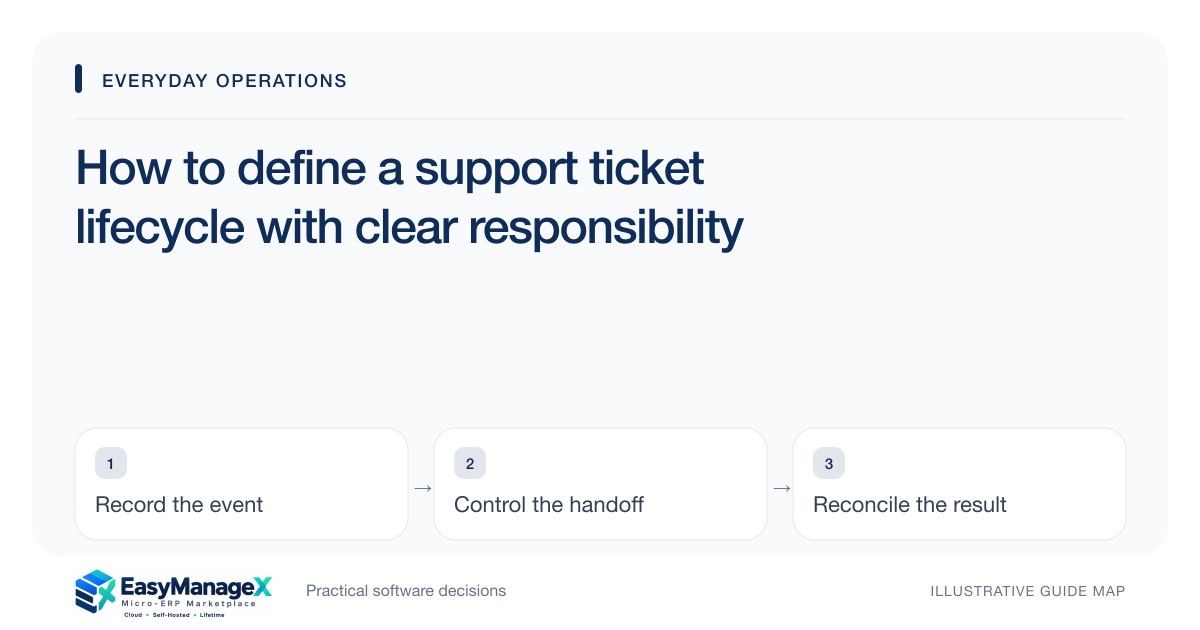
A support ticket lifecycle should explain who owns the next action, why a request has its priority, what information is missing and what evidence allows closure. Separate internal work states from customer communication. Design reassignment and escalation early, because a ticket that changes teams should retain its history and accountable next step.
- Set priority using an agreed impact and urgency rule.
- Keep one accountable owner through handoffs.
- Close against an explicit resolution condition.
Capture enough information for triage
Record the requester, contact route, affected service, issue description and observed impact. Distinguish reported facts from an agent’s interpretation. Structured details help routing, but an overly long form can discourage useful reports or collect information the support team does not need.
Provide a path for incomplete requests. An agent can ask a focused question and record the missing input. Waiting for customer should identify what was requested and when follow-up is due instead of becoming an indefinite parking state.
Make priority consistent across agents
Define impact and urgency in terms your team can apply. An unavailable shared service and a cosmetic issue for one user may require different attention. Record the reason so another agent can understand why a ticket received its initial priority.
Allow reassessment when evidence changes. A ticket initially thought isolated may affect more users, or a workaround may reduce urgency. Keep the reassessment attributable rather than overwriting priority without explaining the new understanding.
Separate ownership from participation
Several specialists can contribute while one person remains accountable for coordination. Specify who updates the customer and who chases internal dependencies. A ticket assigned to a team without an individual responsibility rule can stall between people who each assume someone else is responding.
Write the escalation conditions and route. Escalation may seek expertise, authority or faster coordination; those are different needs. Avoid using escalation solely as a way to move an unresolved ticket out of one agent’s queue.
Illustrative scenario: a delayed repair request
An illustrative equipment-support team receives a report of an intermittent fault. Intake records the symptoms and affected equipment. A technician needs a replacement part, so the ticket keeps its coordinating owner while procurement receives a linked action for availability.
The owner tells the customer what remains uncertain and sets the next update time. When the part arrives, the technician records the repair and verification result. The owner checks the agreed resolution condition before closure instead of assuming part delivery alone resolved the reported fault.
Define closure and reopening evidence
A resolution record should explain what changed, what was checked and any remaining limitation. Where customer confirmation matters, represent that separately from internal completion. Define when a follow-up response reopens the ticket and when it creates a new related request.
Retain useful knowledge without copying sensitive customer details into a general article. A reusable troubleshooting note can describe the symptom and procedure in neutral terms. Decide who reviews that note before other staff rely on it.
Evaluate queues and communication exceptions
Test reassignment, a customer response after closure, an unavailable specialist and an undelivered update. Ask what the candidate workflow displays to the next agent and how outstanding commitments are reviewed. A ticket count alone does not show the quality of coordination.
Have the receiving agent reconstruct the sample request and identify its next customer commitment from the record. Confirm notification-provider behaviour separately from ticket status. Operational targets need documented measurement rules, working hours and ownership before they are meaningful; a field labelled SLA does not supply those decisions.
Your working checklist
- Define required triage fields.
- Write impact and urgency examples.
- Assign the customer-update owner.
- Specify escalation purpose and route.
- Document closure and reopening criteria.
- Test failed communication and reassignment.
Common questions
Can multiple people own one support ticket?+
Multiple contributors are often useful, but one accountable coordinating owner prevents ambiguous next steps. Name specialist actions separately and define who keeps the customer informed. If ownership changes, require the receiving person to understand the current issue, outstanding promises and next action before the handoff is treated as complete.
Should a ticket close when an agent finishes work?+
Use the agreed closure condition for the request. Some work needs customer confirmation or a verification period, while other requests can close on documented completion. Keep internal completion distinguishable from final closure when necessary so a team does not report resolution before the relevant evidence exists.
Does an SLA label establish a service guarantee?+
No. A catalogue label does not define the measurement rules, support hours, exclusions or contractual terms of a service commitment. Document those details separately and verify how a candidate implementation measures them. Operational targets should be understandable to agents and customers without implying an unsupported guarantee.
Sources and further reading
These primary references explain relevant concepts. Our scenarios and working checklists are original, illustrative guidance.
- OWASP Logging Cheat Sheet
Guidance on useful event context and appropriate handling of sensitive support evidence.
- OWASP Authorization Cheat Sheet
Guidance relevant to restricting ticket and evidence access.
Published by EasyManageX as practical, AI-assisted guidance. Examples are illustrative. Confirm software capabilities, licence terms and project-specific requirements before committing. Read our editorial policy.