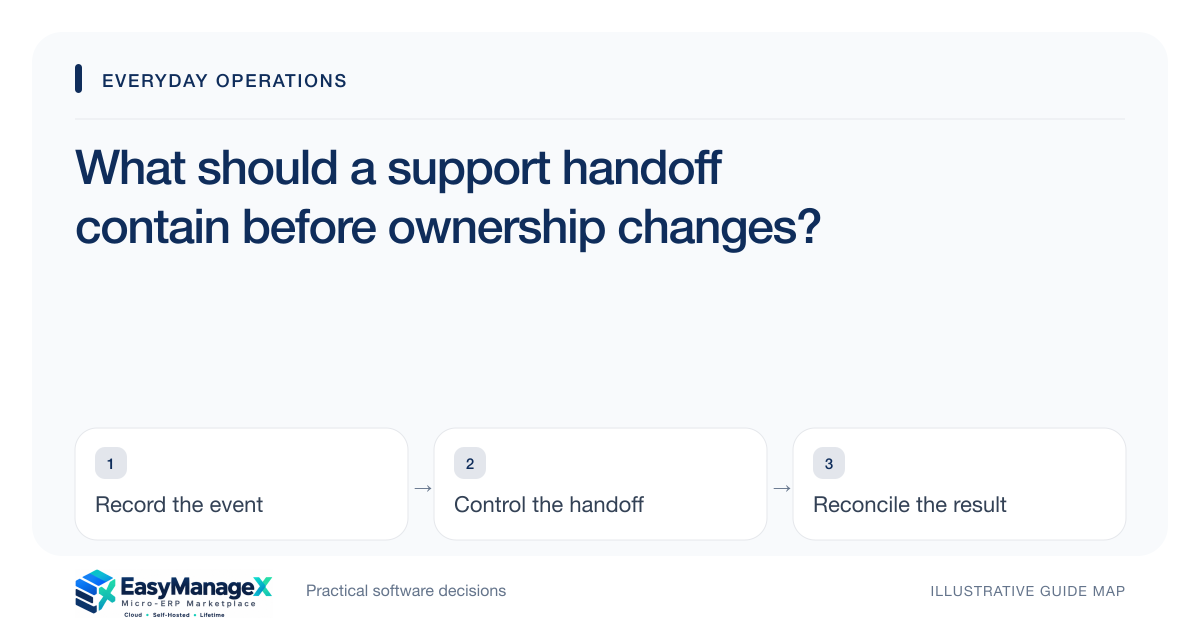
A support handoff should contain the current problem, confirmed evidence, attempted actions, unresolved dependencies, customer promises and the next expected action. Name the receiving owner and require enough acceptance to establish responsibility. Changing an assignee field is insufficient when the next agent must rediscover the issue or does not know that a customer update is due.
- Transfer the next commitment as well as ticket context.
- Record evidence and hypotheses separately.
- Keep responsibility until the receiving owner accepts it.
Describe the current problem succinctly
State the requester’s current issue and operational impact, including any changes since intake. A useful summary distinguishes what is confirmed from what remains suspected. Avoid forcing the next agent to read every comment before understanding why the request is still open.
Include the relevant affected service or asset and stable references. If several records describe the issue, link them rather than copying conflicting summaries. The receiving owner needs a coherent starting point that can be checked against original evidence.
Preserve attempted actions and their results
Record what was tried, when and what happened. A list of actions without outcomes can cause the next agent to repeat failed work. Include limitations in the observation so a test performed under different conditions is not treated as a universal conclusion.
Keep sensitive logs or attachments in an appropriately restricted place. The handoff can reference them and explain their relevance without exposing unnecessary personal or confidential details to everyone who views a general ticket queue.
Carry forward customer commitments
List promised updates, scheduled visits and requested evidence with dates and owners. A technical handoff often fails because those commitments stay in the previous agent’s private messages. The new owner should know what the customer expects next.
Distinguish an internal target from a promise communicated externally. If the target cannot be met, assign responsibility for a revised update. Do not silently move the date and leave the customer believing the original commitment remains accepted.
Illustrative scenario: an evening shift change
An illustrative service desk transfers an unresolved network issue at shift change. The outgoing agent records the affected site, observed symptoms and tests completed, plus the supplier response still awaited. The customer has been promised an update the next morning.
The incoming agent checks the context and accepts responsibility for that update before the outgoing shift ends. A linked supplier action remains with its specialist owner. The transfer preserves coordination instead of treating the supplier dependency as a reason that nobody owns the customer communication.
Define acceptance and escalation
Choose a lightweight acceptance method appropriate to the workflow: explicit acknowledgement or a documented queue-assignment rule with accountable coverage. State what happens when the receiving person is unavailable or lacks the necessary authority. Unaccepted transfers need an escalation owner.
Do not confuse acceptance of responsibility with agreement that the prior diagnosis is correct. The next owner may reassess the issue while preserving earlier observations. The handoff’s purpose is continuity, not forcing a colleague to inherit an unsupported conclusion.
Measure continuity with meaningful exceptions
Review tickets that missed updates, bounced between teams or required repeated discovery. Use those records to refine the handoff fields and coverage rules. Counting reassignments alone cannot show whether the transfers were appropriate or whether continuity improved.
Test the next shift’s ability to identify the promised update and supporting evidence without consulting the outgoing agent. Confirm restricted attachments and unavailable-recipient handling. A meaningful handoff leaves responsibility and action clear; a changed assignee field or reset target date does not establish that continuity.
Your working checklist
- Summarise the current issue and impact.
- Separate observations from hypotheses.
- List attempted actions and outcomes.
- Transfer dated customer commitments.
- Name the receiving owner and acceptance rule.
- Escalate unaccepted or unavailable handoffs.
Common questions
Is changing the assigned agent enough for a handoff?+
It can update a record, but it does not by itself establish that the next agent understands the issue or accepted the outstanding commitments. Define the context and acceptance rule your team needs. Keep responsibility clear while the transfer is pending, especially around shift changes or specialist escalation.
How detailed should a handoff note be?+
Include enough information to identify the issue, verified evidence, attempted actions, blockers and next commitments without recreating the whole history. Link supporting records for detail. A concise structured summary is useful when it helps the next owner act; a long unorganised transcript may still leave the important decision unclear.
Who owns customer updates while a specialist investigates?+
Name a coordinating owner even when a specialist owns the technical action. The coordinator tracks progress and communicates the agreed updates. This avoids leaving the customer waiting because every team considers the unresolved technical dependency someone else’s responsibility, while preserving specialist authority over the actual investigation.
Sources and further reading
These primary references explain relevant concepts. Our scenarios and working checklists are original, illustrative guidance.
- OWASP Logging Cheat Sheet
Guidance on useful event context, attribution and restricted sensitive evidence.
- OWASP Authorization Cheat Sheet
Guidance relevant to protecting support attachments and access paths.
Published by EasyManageX as practical, AI-assisted guidance. Examples are illustrative. Confirm software capabilities, licence terms and project-specific requirements before committing. Read our editorial policy.