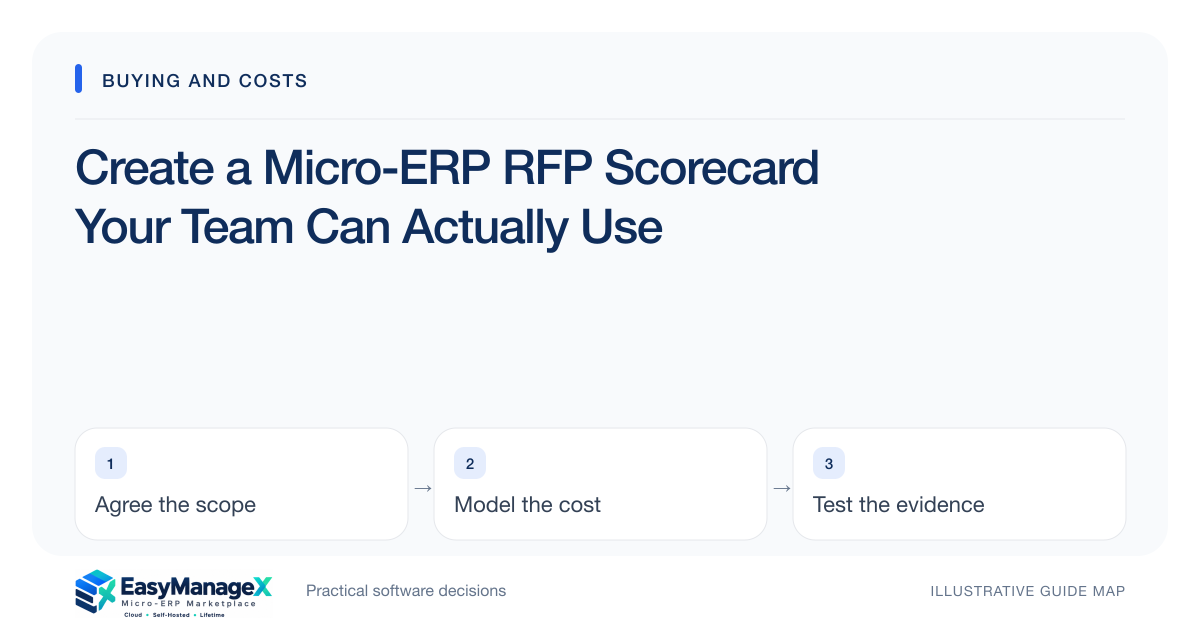
A micro-ERP RFP should describe your operating scope and ask candidates for comparable evidence, implementation plans and costs. Use a small weighted scorecard, but keep essential acceptance gates outside the average. Evaluate answers through demonstrations and sample exports so polished proposals do not outrank an option that actually fits the workflow.
- Keep essential gates separate from weighted preferences.
- Require the same evidence from every candidate.
- Record dependencies beside every proposed capability.
Describe the purchase clearly
Start the request with the workflow, users, locations and systems that stay in place. Include representative transaction volumes and known exceptions. A candidate should understand what must change and what is excluded before estimating implementation effort or selecting a suitable commercial offering.
Ask for responses using your requirement identifiers. This makes follow-up precise and discourages large generic presentations. Give space to explain native functionality, configuration, third-party dependency and custom development separately; these routes may all work, but carry different cost and maintenance responsibilities.
Choose a compact scorecard
Select criteria your evaluators can actually judge: workflow fit, exception handling, usability, portability, operating responsibilities and complete cost. Assign weights before reviewing proposals and explain the reason for each. Weighting should reflect the selected process rather than the loudest participant or the latest attractive demonstration.
Define score meanings with examples. A high fit score should require observed completion of essential scenarios, while a partial score records a workable limitation. Avoid vague labels such as excellent unless reviewers share a definition. Record evidence next to the score so it can be challenged constructively.
Protect non-negotiable gates
Some conditions cannot be compensated by cheaper pricing or a prettier dashboard. If an essential export or separation of duties is absent, treat it as a gate requiring resolution. Keep that result visible outside the weighted average rather than allowing strengths elsewhere to conceal it.
Do not invent unnecessary gates simply to favor a candidate. Tie every gate to a documented business requirement and specify how to verify it. When the team accepts a limitation, record the compensating process, accountable owner and ongoing effort before changing the gate status.
Apply an illustrative scoring model
Illustrative scenario: a service company weights workflow fit at 35 points, usability at 20, ownership at 20, portability at 15 and cost at 10. It separately requires branch-restricted access. A strong total cannot pass a candidate whose branch restriction remains untested.
The numbers are an original example, not an industry benchmark. The company tests ticket intake, assignment, parts usage and closure using the same data for each candidate. It then adjusts individual evidence scores, without changing weights merely because a favored proposal performs poorly.
Evaluate the implementation response
Request a plan with milestones, customer responsibilities, data assumptions and acceptance evidence. Ask who configures permissions, reconciles imported records and trains users. A short implementation estimate is not necessarily better if it assumes your team will do substantial unpriced work or skips meaningful validation.
Require clarification of support handover and ongoing maintenance. Record which roles are covered by the supplier and which remain internal. Have commercial terms reviewed through the appropriate process, while keeping operational responsibilities understandable to the people who will run the application after launch.
Make the selection traceable
Hold a scoring review after demonstrations. Compare disagreements by examining observed behavior rather than averaging unexplained opinions. Maintain a decision log with rejected alternatives, unresolved conditions and the reasons for selection. This record helps when scope changes or new stakeholders join implementation later.
Use the scorecard as a living acceptance reference once a candidate advances. Promised capabilities should become testable deliverables. EasyManageX categories can organize discovery, but catalogue entries are illustrative and do not replace supplier evidence, confirmed availability or a proposal for your particular requirements.
Your working checklist
- Describe scope and exclusions.
- Number each requirement.
- Agree weights before proposals arrive.
- Separate essential acceptance gates.
- Request evidence and dependencies.
- Compare implementation responsibilities.
- Record the selection rationale.
Common questions
Do small businesses need a formal RFP?+
They need comparable questions and a documented decision, even if the request is only a few pages. Scale the format to the purchase. A concise scenario pack and cost worksheet can be sufficient when requirements are clear and only a small shortlist is involved.
Should the cheapest candidate receive the highest cost score?+
Compare complete costs under the same workload assumptions, then apply the agreed scoring definition. A low licence price may exclude hosting, training or support. Record financial uncertainty separately so an incomplete estimate does not receive an advantage over a transparent, complete proposal.
Can weights change during evaluation?+
They can change if the underlying business priorities genuinely change, but document why and rescore every candidate consistently. Avoid changing weights merely to produce a preferred winner. Important new evidence may instead require updating a requirement, gate or implementation assumption.
Sources and further reading
These primary references explain relevant concepts. Our scenarios and working checklists are original, illustrative guidance.
- IBM: What is enterprise resource planning?
ERP integration and shared operational data; vendor-neutral original guidance in our articles.
- OWASP Authorization Cheat Sheet
Least privilege, deny by default and permission verification.
Published by EasyManageX as practical, AI-assisted guidance. Examples are illustrative. Confirm software capabilities, licence terms and project-specific requirements before committing. Read our editorial policy.