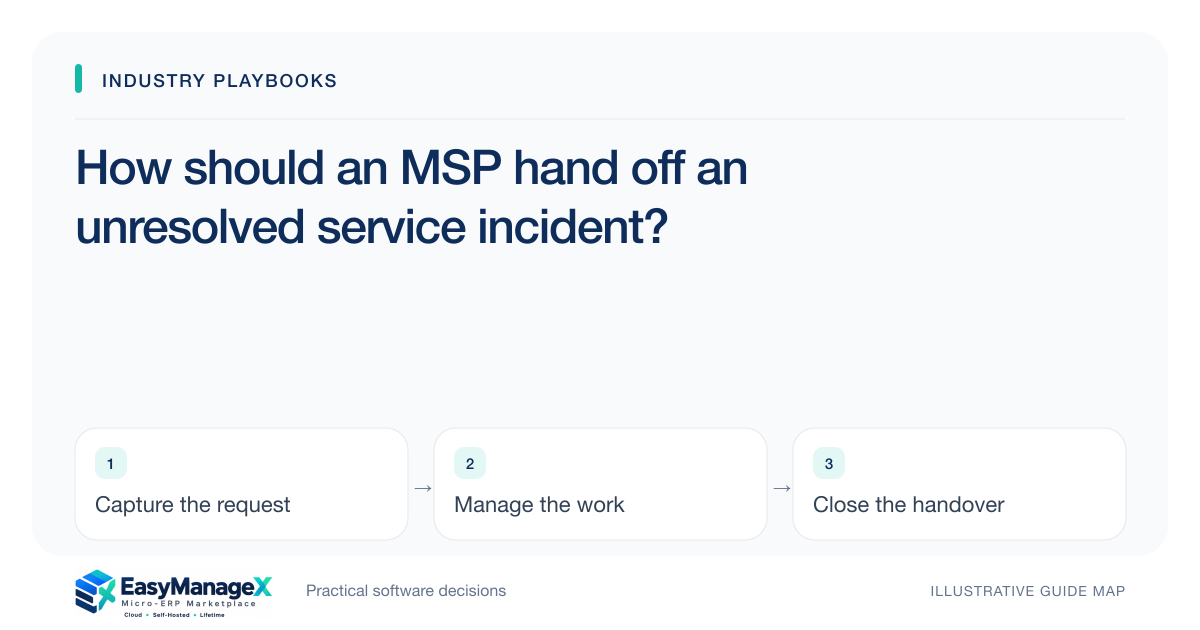
An MSP incident handoff should identify the customer service, observed impact, actions already taken and the next responsible owner. Keep technical work, customer communication and pending approvals linked but distinct. The receiving technician needs usable evidence and unresolved questions, while the communication owner should publish only confirmed information appropriate to the customer’s access and service arrangement.
- A handoff needs evidence and unresolved questions.
- Technical ownership and communication ownership can differ.
- Keep credentials out of general incident notes.
Identify the affected service and observed impact
Record the customer account, service reference and observed issue using the identifiers your team maintains. Distinguish reported symptoms from confirmed findings. A vague ticket title such as system down can mislead the next technician when only one component or user group has been verified as affected.
Capture the relevant time references and reporting source without inventing a complete incident timeline. If an event time is uncertain, label it accordingly. The incoming owner needs to know which observations are dependable and which questions still require investigation.
Preserve work already performed
Record meaningful actions, their outcomes and evidence references at a level another technician can use. A note saying checked everything does not explain what changed. Keep proposed next actions separate from work that actually occurred, particularly when they require approval or another service owner.
Avoid storing credentials, secret values or unnecessary customer data in incident notes and logs. Use the organisation’s established secure handling process for access. The general handoff should reference the appropriate authorised route rather than expose sensitive information to everyone who can search tickets.
Assign the next owner explicitly
An escalation needs a receiving role or person, reason and next review time. Record acknowledgement where the process requires it. Moving a ticket into a team queue does not establish that a technician has accepted responsibility for a time-sensitive next action.
Customer communication may have a separate owner. Provide that person with confirmed impact, current decision state and the next update arrangement. Do not turn an untested technical hypothesis into a customer-facing explanation simply because it appears as the latest comment.
Illustrative scenario: an incident crosses shifts
Imagine a technician investigates a reported service interruption near shift end. One observation is confirmed, another remains uncertain and a proposed change needs approval. The handoff identifies the evidence, unresolved question and receiving owner before the outgoing technician finishes.
The customer communication owner records an update using the confirmed state and agreed next contact time. This illustrative scenario explains responsibility and evidence; it does not prescribe remediation steps or promise recovery timing, service availability or any listed product’s integration capability.
Close technical work and communication carefully
A technical resolution reference and customer communication completion may occur at different times. Keep both visible so the team does not close a ticket while an agreed update or approval follow-up remains outstanding. Record the authorised closure decision under the service process.
If the incident recurs, link the new observation to relevant earlier work without assuming the cause is identical. Preserve the earlier outcome and the current evidence. This gives the next owner useful context while preventing an old explanation from substituting for a fresh investigation.
Evaluate a handoff with pending approval
Demonstrate an incident with one confirmed observation, a restricted evidence attachment and a proposed action awaiting approval. Escalate it across shifts and inspect the receiving account. Ask how the communication owner distinguishes verified information from a working hypothesis.
EasyManageX concepts are illustrative. Confirm service references, permissions and escalation acknowledgement through your own fictional incidents. A focused pilot should establish reliable ownership and evidence habits before the team relies on wider automation or assumes that a dashboard proves operational recovery.
Your working checklist
- Use customer and service identifiers consistently.
- Separate observations from hypotheses.
- Record actions and evidence references.
- Keep secrets outside general notes and logs.
- Assign receiving and communication owners.
- Test shift handover with a pending approval.
Common questions
Does assigning a team queue complete escalation?+
A queue assignment routes work, but your process may also need acknowledgement and a named next action. Define what responsibility means for the receiving team. Verify that urgent unresolved tasks remain visible when a ticket changes queues or the original technician ends their shift.
What should a customer update contain?+
Use confirmed information appropriate to the service arrangement: observed impact, current decision state and the next update plan. Keep untested hypotheses and sensitive technical detail separate. The communication owner should know which facts were verified rather than repeat the latest unrestricted ticket comment.
Should we reuse the previous resolution for recurrence?+
Link the history as context, but record the new observations and responsible review. Similar symptoms do not independently prove an identical cause. Preserve earlier work while identifying current evidence and next actions, so the handoff supports investigation rather than assuming that the old explanation settles the new incident.
Sources and further reading
These primary references explain relevant concepts. Our scenarios and working checklists are original, illustrative guidance.
- AWS Well-Architected Reliability Pillar
Reliability and recovery planning principles; relevant to clear incident ownership and unresolved work during an MSP escalation.
- OWASP Logging Cheat Sheet
Further reading on preserving meaningful event history while excluding sensitive information from routine logs.
Published by EasyManageX as practical, AI-assisted guidance. Examples are illustrative. Confirm software capabilities, licence terms and project-specific requirements before committing. Read our editorial policy.