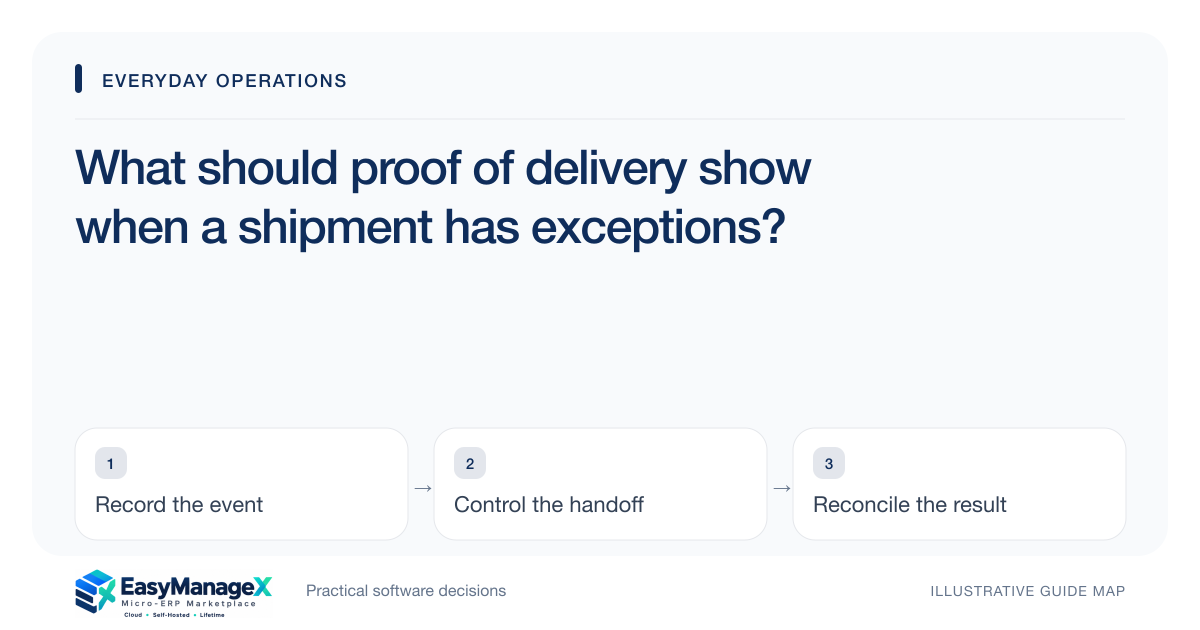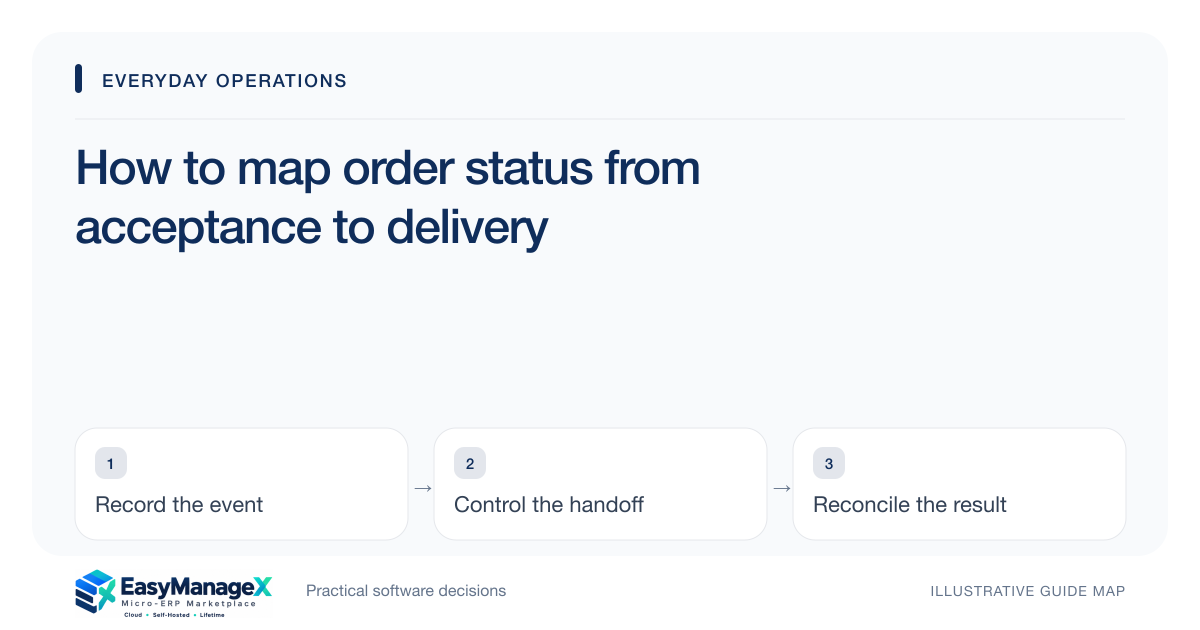
Order status should represent evidence of fulfilment progress, from acceptance through allocation, picking, dispatch and delivery. Define the owner and reference at every handoff, and allow partial outcomes where your business needs them. A single fulfilled label can conceal shortages or failed delivery, so evaluate the whole order journey using realistic exceptions.
- Accept orders against a clear availability decision.
- Keep dispatch distinct from confirmed delivery.
- Explain partial fulfilment at line and order level.
Define what order acceptance promises
An accepted order needs an agreed item or service, quantity, destination and expected fulfilment terms. Determine who confirms availability and which assumptions remain tentative. A quotation or enquiry should not quietly become an accepted commitment because a staff member created a record.
Record the relevant customer reference and stable internal order ID. Those identifiers support questions across sales, warehouse and delivery teams. Ensure changes retain their identity so an amended order is not mistaken for a second independent customer request.
Separate allocation from picking
Allocation reserves available stock or capacity for the order. Picking records the physical selection of goods. Keeping the distinction helps staff explain why an order is reserved but not yet ready to dispatch, especially when orders compete for limited stock.
Specify what happens when the picker finds less usable stock than expected. A shortage may require partial dispatch, replenishment or a customer decision. Do not conceal the exception by changing the requested quantity without an accepted amendment.
Make dispatch a custody handoff
Dispatch should identify what left, when, from where and with which delivery reference or responsible party. Confirm the package or line quantities and any relevant handling instructions. A dispatch record should help the next team understand custody rather than merely change a status colour.
Provide a correction path for an incorrectly labelled or incomplete dispatch. Keep the original reference and the resolution visible. An order can be dispatched accurately and still fail to reach the intended recipient, so delivery needs its own evidence.
Illustrative scenario: a partly available wholesale order
An illustrative wholesaler accepts an order for several lines. One line is short during picking. Sales obtains the customer’s decision to receive the available goods first and records the outstanding line with its expected next action.
The first dispatch has its own quantities and reference. Delivery confirms only that shipment, while the order remains partially fulfilled. This allows customer service to explain what arrived and what remains without marking the entire order complete or creating an unconnected replacement order.
Handle failed and partial delivery
Define evidence for successful delivery and distinguish attempts, refusals, damage and recipient absence. Assign responsibility for resolving each exception. A carrier update may be useful evidence, but the required acceptance condition depends on your business and agreed delivery terms.
Keep returns linked to the delivery and original order where practical. Returning a package, accepting goods back into stock and resolving the financial outcome are different decisions. Their relationship should remain traceable without forcing them into a single instant status change.
Review the customer-facing explanation
Ask staff to explain a sample order using only its records. They should identify the accepted promise, completed steps, current owner and next action. If they need private messages to reconstruct the position, the handoff design needs more context.
Run the explanation exercise with sales, warehouse and customer-service colleagues. Verify that the agreed quantities and references remain consistent in their views and exports. Any courier connection needs separate proof of actual provider events; a status field alone cannot establish that dispatch or recipient acceptance occurred.
Your working checklist
- Define the accepted order commitment.
- Choose stable order and shipment IDs.
- Separate allocation and picking states.
- Document partial-fulfilment decisions.
- Specify dispatch custody evidence.
- Assign failed-delivery resolution owners.
Common questions
Can one order have several deliveries?+
Yes, if your fulfilment model permits partial shipments or different delivery routes. Preserve quantities and references for each shipment and maintain the remaining obligation at order level. This avoids treating the first successful delivery as evidence that every ordered line has reached the customer.
Should dispatch automatically complete an order?+
Only if completion is explicitly defined as dispatch in your process and communicated accordingly. When delivery acceptance matters, keep it separate. A shipment leaving the warehouse is evidence of a custody handoff, while a successful delivery requires the evidence defined by your business and agreed terms.
What should staff do when picking finds a shortage?+
Record the observed shortage against the relevant line and assign a decision owner. That person can assess replenishment, partial fulfilment or an agreed amendment. Preserve the customer’s original request and accepted resolution so subsequent teams understand why the dispatch differs from the initial order.
Sources and further reading
These primary references explain relevant concepts. Our scenarios and working checklists are original, illustrative guidance.
- Microsoft Learn: Inventory on-hand list
Further reading on available quantities and stock dimensions.
- IBM: What is enterprise resource planning?
Background on connecting fulfilment and related operational records.
Published by EasyManageX as practical, AI-assisted guidance. Examples are illustrative. Confirm software capabilities, licence terms and project-specific requirements before committing. Read our editorial policy.