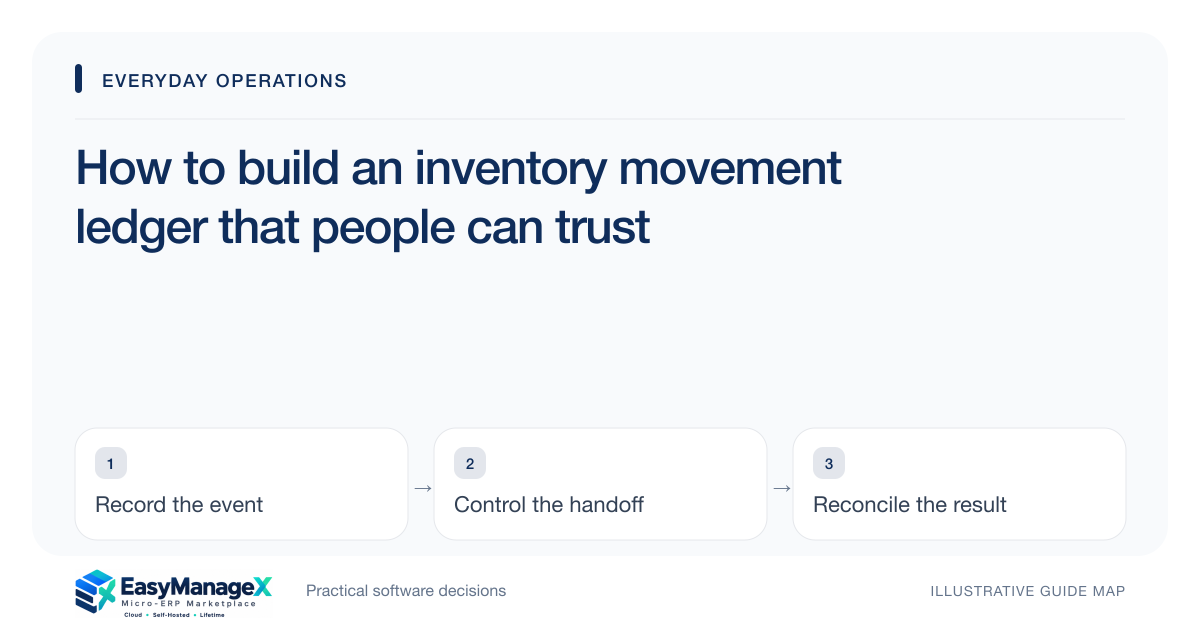
A dependable inventory ledger explains each quantity change with an item, location, unit, time, reason and source reference. Start by separating physical movements from reservations and corrections. Agree who records each event and how mistakes are reversed. A single stock total cannot show why stock changed or whether it is actually available to promise.
- Record item, location and unit on every movement.
- Keep reservations separate from physical stock changes.
- Correct errors with attributable reversal or adjustment records.
Choose the stock identity carefully
Inventory identity may include a variant, batch or serial number as well as the item code. Decide which distinctions your operation needs before importing records. Combining unlike items creates a convincing total that staff cannot physically locate or count.
Units deserve equal attention. A carton receipt and an individual-unit sale must have a documented conversion. Decide where conversion factors are maintained and how changes affect future transactions without rewriting the meaning of previous movements.
Distinguish receipt from availability
Receiving goods establishes that they arrived; it may not establish that they can be sold. Inspection, damage review or putaway can delay availability. Define which event makes stock available and who confirms it rather than assuming every receipt immediately increases usable stock.
Include a source reference such as a purchase order or transfer request. Differences between expected and received quantities should remain visible. A receipt exception needs a decision about the shortage or excess, not just a changed number.
Make transfers visible at both ends
A transfer has an origin, destination and movement identity. If dispatch and receipt happen at different times, represent goods in transit so they do not appear available in both locations. Decide who investigates a transfer that remains incomplete.
Avoid modelling a transfer as two unrelated adjustments. The linked record lets a reviewer compare the quantity sent with the quantity accepted. Partial receipt, damaged arrival and cancellation each need an explicit outcome with retained evidence.
Illustrative scenario: spare parts across locations
An illustrative repair business moves twelve filters from its main store to a workshop. Dispatch reduces main-store availability and marks the filters in transit. The workshop accepts eleven because one is damaged and records that exception against the transfer.
The team can now locate eleven usable filters and one disputed item. A single immediate transfer of twelve would hide the damage; unrelated stock adjustments would make the two locations harder to reconcile during a later count.
Separate reservation from consumption
A reservation earmarks stock for a demand; consumption or dispatch records its physical use. Define when reservations expire, whether they can be partially released and who may override them. Otherwise old demand can indefinitely reduce apparent availability.
Review whether negative availability is allowed and under what conditions. Some operations need controlled backorders, while others must prevent promises exceeding usable stock. A candidate tool should demonstrate the chosen policy using competing demands for the same item.
Set correction and review rules
An adjustment needs an observed quantity, expected quantity, reason, location and reviewer when appropriate. Use a reversal for an incorrectly recorded movement where practical, preserving the original trail. Do not let unexplained adjustments become the normal way to make totals match.
Request a movement export that includes references, locations, units and correction reasons, then reconcile a selected item independently. The ledger should explain the balance without private notes. Confirm that the candidate process handles the agreed stock identity and reservation rules rather than relying on aggregate dashboard totals.
Your working checklist
- Define item variants, batches and units.
- List stock locations and in-transit states.
- Choose the availability event after receipt.
- Link both sides of each transfer.
- Document reservation release rules.
- Assign adjustment reasons and reviewers.
Common questions
What is the difference between stock and available stock?+
Physical stock describes goods present in defined locations. Available stock depends on reservations, inspection holds, damage and other restrictions you choose to model. Write the calculation explicitly so purchasing, sales and warehouse staff use the same meaning when deciding what can be promised or replenished.
Can we start with only one warehouse location?+
Yes, if one location reflects your real process. Still record the location consistently so later expansion does not require guessing where old movements occurred. Introduce separate locations or states when they represent meaningful custody or availability differences, rather than adding detail merely because a system offers it.
How should an incorrect receipt be corrected?+
Preserve the original receipt reference and use a reversal or attributable correction according to your agreed procedure. Record why the quantity was wrong and what evidence supports the correction. Deleting the original event can make supplier disputes and subsequent stock reconciliation difficult to explain.
Sources and further reading
These primary references explain relevant concepts. Our scenarios and working checklists are original, illustrative guidance.
- Microsoft Learn: Inventory on-hand list
Further reading on inventory dimensions and available quantities.
- ERPNext documentation: Stock Reconciliation
Further reading on reconciling physical observations with recorded balances.
Published by EasyManageX as practical, AI-assisted guidance. Examples are illustrative. Confirm software capabilities, licence terms and project-specific requirements before committing. Read our editorial policy.