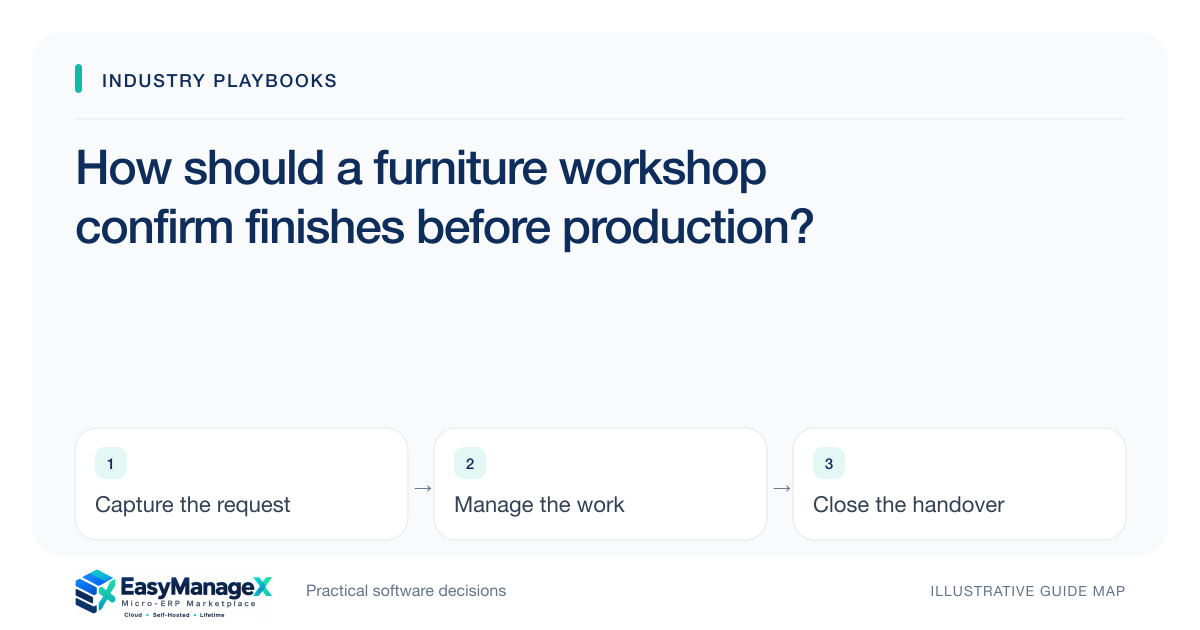
A furniture workshop should release production against a clearly identified approved specification, including finish references and unresolved decisions. Keep customer sample discussions separate from confirmed instructions, and record who authorised the release. Later revisions need a documented review of work already underway, followed by acknowledgement from affected workshop stages rather than a silent replacement of the drawing.
- A sample discussion is not a confirmed finish instruction.
- Release work against an identified specification version.
- Review revisions for effects on work already started.
Collect decisions in a specification register
List the decisions needed before the workshop can proceed: dimensions, material references, finish, fittings and any customer-approved details. Each needs an owner and state. A folder containing many drawings and photographs does not tell the craftspeople which choices remain unresolved.
Give the specification a version and link each relevant sample or reference to it. Use identifiers staff can find on the workshop instructions. Avoid relying only on a colour name, because customer conversations and supplier descriptions may use the same words for different references.
Record approval with its scope
An approval should identify what was shown, which version was accepted and any limitations recorded by the authorised project owner. A customer agreeing to a finish sample does not automatically approve an unrelated dimensional change made later in the drawing set.
Keep pending decisions separate from approved ones. The release owner should be able to identify which work can proceed and which requires further confirmation. A broad “approved” flag at project level can conceal a single unresolved detail that affects the next workshop stage.
Release work through a named handoff
The workshop release needs specification version, relevant attachments and receiving stage owner. Record acknowledgement so the project coordinator knows which instructions reached the floor. Printed or offline instructions need a practical way to identify their version during a later revision.
When a change is proposed after release, ask the workshop owner what has already occurred. The record should describe affected components and required decisions without assuming that an edited drawing automatically makes earlier work recoverable. Keep operational feasibility and commercial approval connected but distinct.
Illustrative scenario: a cabinet finish changes late
Imagine a customer requests a different cabinet finish after one component has entered finishing. The coordinator links the request to the current approved version and asks the workshop lead to identify affected work. The authorised owner records the accepted scope before issuing revised instructions.
The finishing team acknowledges the revision, while completed components remain visible for a separate decision. This illustrative scenario concerns specification control; it does not prescribe finishing techniques, material compatibility or the commercial outcome for the customer’s late request.
Preserve the production and handover evidence
Keep the version used for each released work package, rather than assuming the newest project document describes all completed work. At handover, the responsible person can compare delivered components with the approved record and identify any documented exceptions.
If staff correct an incorrectly labelled reference, preserve the correction reason and affected work. A quiet filename replacement can leave a printed sample label and the digital register describing different instructions. Record the reconciliation so the next person understands which reference is authoritative.
Evaluate the awkward revision case
Ask a demonstrator to approve one finish, release work, propose a late change and retain a completed component under review. Inspect the workshop account and the project handover view. Both should identify the approved version and the unresolved decision.
EasyManageX listings are illustrative. Verify specification links, approval scope and acknowledgement through a real sample project. A small pilot can establish the minimum references craftspeople need before the business adds a complex document structure that is difficult to use on the workshop floor.
Your working checklist
- List decisions required before production release.
- Assign versions to specification sets.
- Identify physical finish samples clearly.
- Record approval scope and limitations.
- Require workshop acknowledgement of released instructions.
- Test a late revision affecting completed work.
Common questions
Does approval of a sample approve the whole project?+
Record the scope explicitly rather than assuming it. A finish sample, dimensions and fittings can represent separate decisions. The release owner needs to see which requirements were confirmed and which remain unresolved, so an approval in one category does not silently authorise changes elsewhere.
How should printed drawings be handled after a revision?+
Use clear version identifiers and a handoff procedure that tells the relevant workshop owner which instruction changed. Record acknowledgement and the affected work. Preserve the earlier version for explanation instead of relying on a file replacement that cannot update copies already circulating on the floor.
Can software decide whether a late finish change is feasible?+
It can gather the affected specification, production state and required approvals. Feasibility remains a decision for the workshop’s responsible personnel using their established process. Record their outcome rather than treating a successfully edited drawing as proof that completed work can be changed appropriately.
Sources and further reading
These primary references explain relevant concepts. Our scenarios and working checklists are original, illustrative guidance.
- ERPNext documentation: Project
Further reading on work packages and project ownership; relevant to furniture specification approvals and workshop release handoffs.
Published by EasyManageX as practical, AI-assisted guidance. Examples are illustrative. Confirm software capabilities, licence terms and project-specific requirements before committing. Read our editorial policy.