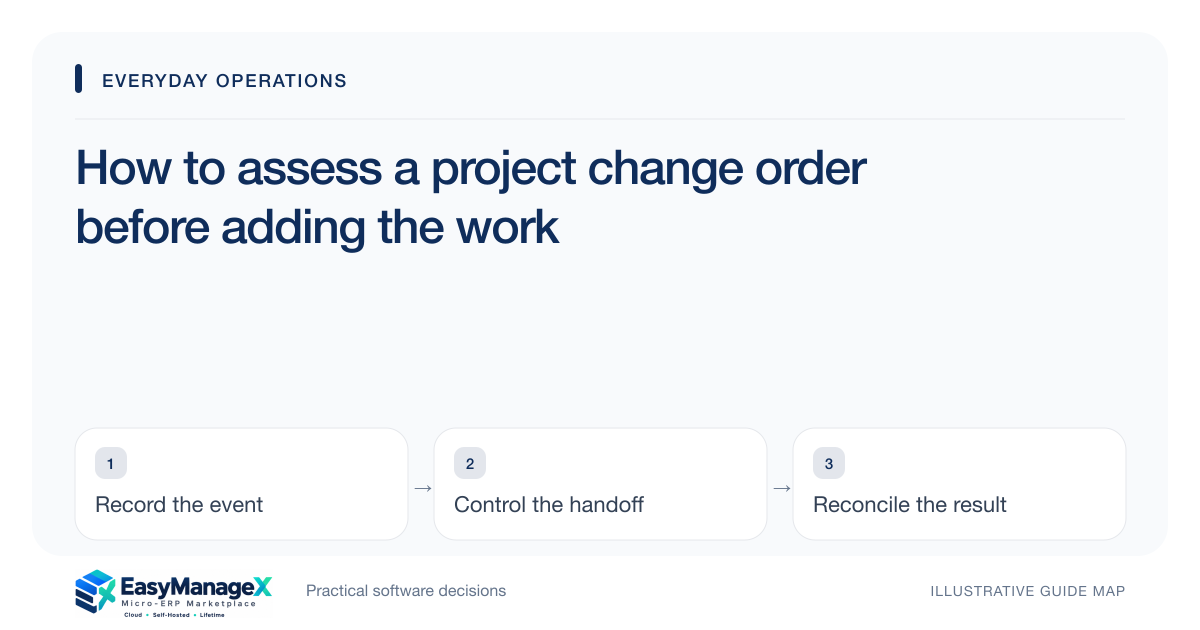
Assess a change order by comparing the request with accepted scope and identifying its effect on deliverables, effort, cost, dependencies and timing. Name the decision maker and preserve the accepted amendment before committing additional work. A customer comment or internal task edit should not silently become authorisation for a material change to the project.
- Compare the request with an identifiable accepted baseline.
- Assess affected work and dependencies before approval.
- Update the plan only against an attributable decision.
Capture the requested change clearly
Describe the proposed outcome, requester, reason and relevant work reference. Separate what was requested from the team’s interpretation or proposed response. Ambiguous requests need clarification before estimating consequences or adding tasks to the active plan.
Identify the accepted baseline being changed. That may be a brief, deliverable list or specification version. Without it, the team can disagree over whether the request is genuinely additional work or merely clarifies an obligation already accepted.
Assess impact beyond the immediate task
Consider effort, purchased materials, shared capacity, review steps and downstream dependencies. A small visible change can affect several work packages. Explain the assumptions and uncertainties in the assessment instead of presenting a precise estimate unsupported by investigation.
Identify work already completed or committed. A change can require rework or cancellation, and those effects should be visible. The assessment is useful when it gives the decision maker an understandable tradeoff, not merely a larger total.
Define who can accept the amendment
Name the people authorised to accept delivery and commercial consequences. The customer requester may lack authority to approve the revised commitment. Internally, the person estimating work may not be authorised to commit capacity or amend terms.
Distinguish approval to investigate from approval to execute. A team can reasonably spend limited effort assessing a change before the main decision. Record that boundary so a discovery task does not silently authorise the full requested amendment.
Illustrative scenario: an event layout change
An illustrative event-planning project has an accepted venue layout and supplier orders. The client requests a larger presentation area. The project lead checks furniture changes, equipment positioning and supplier timing before presenting the revised delivery options.
The authorised client contact accepts one option with its stated constraints. The lead links that decision to the updated layout, supplier amendments and project tasks. This preserves the change’s context instead of relying on a chat message that site staff interpret as approval for every associated cost.
Update linked records consistently
After acceptance, revise the affected plan and documents with a change reference. Communicate the new conditions to receiving teams, including suppliers where relevant. Keep the previous baseline accessible so the project history explains why dates or quantities changed.
Record rejected or deferred changes too. They can matter when similar requests return later or when stakeholders assume a discussed idea was accepted. A clear decision avoids repeating the same assessment or accidentally delivering an option that remained unapproved.
Review outcomes without rewriting the decision
Compare the accepted change assumptions with what actually happened and use differences to improve future assessments. Keep the original estimate and decision evidence. Replacing them with final actuals can make planning appear accurate while concealing important lessons.
Ask the project lead and delivery team to explain the accepted amendment using its recorded assumptions and affected work. Confirm that rejected options remain distinguishable from commitments. Contractual entitlement and legal interpretation require appropriate professional guidance; the operational history should establish what the team actually decided and changed.
Your working checklist
- Reference the accepted project baseline.
- Clarify the requested outcome and reason.
- Assess effort, cost and dependencies.
- Identify execution approval authority.
- Link accepted changes to revised records.
- Retain rejected and deferred decisions.
Common questions
Is a customer message enough to authorise extra work?+
It depends on the agreed authority and terms, which may require professional review. Operationally, confirm the request, affected scope and authorised decision before committing material work. Preserve the accepted amendment and its conditions so delivery staff do not have to infer authority from an informal conversation.
Should urgent changes bypass impact assessment?+
Use a defined urgent decision path, but still record the known impact, uncertainties and approving person. Urgency changes the available review time; it does not eliminate consequences. Identify provisional assumptions and a follow-up review so the team can explain what was authorised under the circumstances.
Why keep changes that were rejected?+
They explain that an option was considered but not accepted and can prevent later confusion when the same idea reappears. Retain the request, reason and decision proportionately. This history helps stakeholders distinguish discussed alternatives from the actual delivery commitment without restarting the assessment from memory.
Sources and further reading
These primary references explain relevant concepts. Our scenarios and working checklists are original, illustrative guidance.
- ERPNext documentation: Project
Further reading on project work, costing and linked task records.
- OWASP Logging Cheat Sheet
Guidance relevant to retaining attributable change decisions.
Published by EasyManageX as practical, AI-assisted guidance. Examples are illustrative. Confirm software capabilities, licence terms and project-specific requirements before committing. Read our editorial policy.