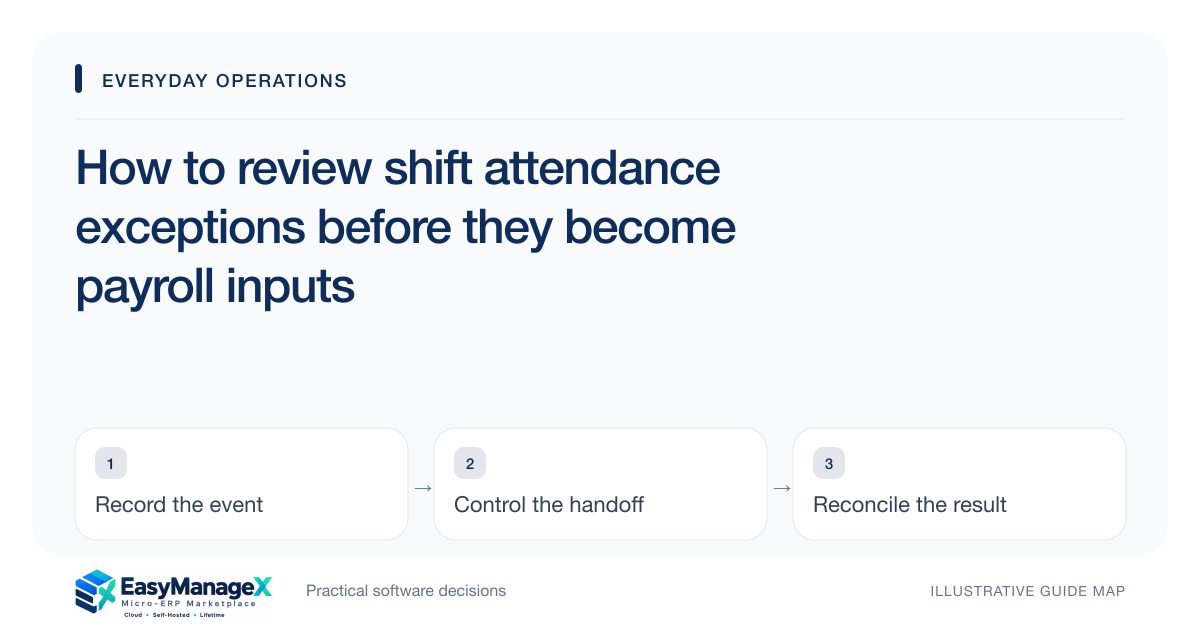
Review attendance exceptions against the employee’s assigned shift and relevant changes, not just calendar-day totals. Identify the original event, expected schedule, observed difference and evidence for correction. Assign a reviewer before the payroll cutoff and preserve unresolved cases. This process improves input quality without deciding employment treatment or payroll calculations on its own.
- Compare events with the assigned shift instance.
- Preserve original events alongside accepted corrections.
- Escalate unresolved inputs before the pay-run cutoff.
Use a shift instance as the comparison
Identify the particular scheduled shift with employee, start, end, location and relevant assignment changes. Overnight work may cross dates, so a calendar-day summary can split one shift incorrectly. Use the agreed shift boundary when reviewing events.
Check that the expected roster is itself accurate. A missing attendance event may reflect an unrecorded shift swap rather than absence. Reviewing against an outdated schedule creates confident but misleading exceptions and can consume time correcting the wrong record.
Classify the observed exception
Distinguish a missing event, duplicate event, unexpected location and event outside the expected period. Each raises a different question. Record the observed issue before deciding its treatment so the reviewer can investigate without inheriting an unsupported conclusion.
Set practical thresholds for review under your policy. A small clock variation and a completely missing shift may need different attention. Those thresholds should prompt assessment rather than automatically establish a payroll or employment consequence.
Gather proportionate correction evidence
Possible evidence includes the accepted roster change, supervisor confirmation or an employee explanation assessed under policy. Record what was used and who reviewed it. Avoid unnecessarily copying private conversation details into a broadly visible attendance note.
Preserve the original event and accepted correction as related records. A reviewer should be able to see whether a time was captured originally or added later. This distinction matters when investigating repeated recording problems or explaining the input supplied for a particular pay period.
Illustrative scenario: a midnight clock-out
An illustrative security team schedules a guard from evening until the following morning. The reporting sheet groups events by calendar date and flags the second date as an incomplete shift. The reviewer compares both events with the actual overnight assignment.
A separate shift swap is confirmed through its approval reference. The accepted correction updates the relevant shift input while retaining the source events. The team resolves two distinct issues instead of filling missing cells with standard hours and obscuring how the inputs were established.
Set ownership and cutoff rules
Name the person responsible for resolving each exception and the deadline for accepted input. Supervisors may supply evidence while another authorised reviewer approves the correction. Define the role split according to the importance and volume of your inputs.
Keep an unresolved status where evidence is insufficient. Payroll staff need to know which cases still require a decision. A completed spreadsheet with uncertain entries is less useful than a clearly identified exception that can be assessed through the agreed process.
Review causes beyond individual corrections
Examine whether exceptions arise from unclear rosters, shared devices, delayed shift updates or inconsistent recording instructions. Fixing those causes can improve the next review period. Do not treat every exception as individual misconduct or assume technology alone resolves the process.
Ask the supervisor and payroll input reviewer to explain the overnight example using the accepted roster and source events. Verify correction authority and access boundaries with actual roles. Employment consequences and payroll calculations require separate qualified guidance; the demonstration should establish reviewed evidence rather than assume a software default is correct.
Your working checklist
- Identify employee shift instances.
- Verify roster changes before review.
- Classify exception types.
- Record proportionate supporting evidence.
- Preserve original and corrected events.
- Assign reviewers and input deadlines.
Common questions
Should overnight attendance be split by calendar date?+
Use the boundary that matches the scheduled shift and the purpose of the review. Calendar-day totals can be useful for some reports, but they may split one overnight assignment incorrectly. Keep the shift identity available so reviewers can interpret events without assuming a missing daily total proves an absence.
Can missing clock events be filled with scheduled times?+
Only when your reviewed procedure permits that treatment and supporting evidence is adequate. Keep the original gap visible and record the reason and reviewer for any added time. Automatically filling every gap can turn uncertain attendance into apparently verified input and hide a recurring recording problem.
Who decides the payroll effect of an attendance exception?+
The authorised payroll or policy reviewer should decide it under the organisation’s reviewed rules and applicable requirements. Attendance review supplies evidence; it does not independently establish the correct financial treatment. Keep that distinction clear and obtain appropriate professional guidance rather than relying on a software default.
Sources and further reading
These primary references explain relevant concepts. Our scenarios and working checklists are original, illustrative guidance.
- OWASP Logging Cheat Sheet
Guidance relevant to retaining original events and correction decisions.
- ERPNext documentation: Role Based Permissions
Further reading on restricting review and edit actions by role.
Published by EasyManageX as practical, AI-assisted guidance. Examples are illustrative. Confirm software capabilities, licence terms and project-specific requirements before committing. Read our editorial policy.