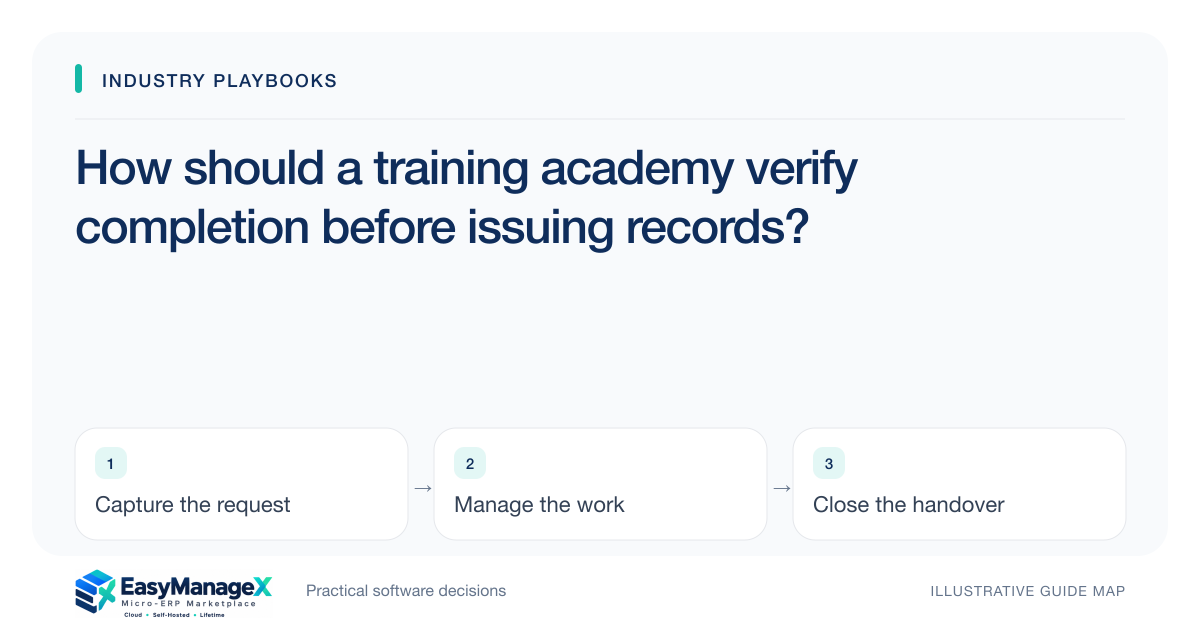
A training academy should define completion criteria before building a status field. Keep attendance, assessment results and required evidence as separate records, then route incomplete or disputed cases to an owner. An authorised release decision should reference the verified course instance and learner identity, while later corrections retain the original record and explanation.
- Completion depends on named criteria, not one checkbox.
- Separate missing evidence from an unsuccessful result.
- Authorise release against a verified learner and course.
Define completion for a course instance
Start with the academy’s published course arrangements and the people responsible for applying them. Different courses may require different attendance, assessment or project evidence. Record the applicable criteria against the course instance rather than assuming every programme uses the same completion rule.
Identify learners consistently across enrolment and assessment records. A shortened name or changed contact detail should not create a second identity. Define how staff resolve mismatches, particularly when information arrives from a visiting trainer or an external assessment file.
Keep evidence categories separate
Attendance records describe participation; assessment records describe an evaluated activity; submitted evidence shows that a required item was received. Keeping these categories distinct makes an unresolved case understandable. A missing trainer upload should not automatically resemble a learner who did not satisfy the academy’s criteria.
Assign ownership for each evidence category. The coordinator can identify a missing result, but the assessor supplies the assessment decision. Record source, date and course instance so administrative staff do not accidentally substitute a result from a previous enrolment.
Give exceptions a decision route
Create explicit states for identity review, missing evidence, disputed result and pending release approval. Each needs a responsible person and next action. Avoid a catch-all “incomplete” label that leaves staff repeatedly asking the learner for information already waiting with a trainer.
Allow reviewers to record an explanation without changing the underlying evidence silently. If a result was entered incorrectly, retain a correction reference. The final release owner should see the corrected record and the unresolved exceptions rather than only the latest green status.
Illustrative scenario: a practical result arrives late
Imagine a short-course learner has recorded attendance and a submitted project, but the practical assessment result has not arrived from the trainer. The coordinator marks the missing result and assigns follow-up. No completion record is issued solely because the other two categories look complete.
When the trainer submits the result, an authorised person reviews the criteria and releases the record for the correct course instance. This illustrative scenario addresses academy administration; it does not claim accreditation, qualification recognition or a particular professional eligibility outcome.
Make release and correction traceable
Record who authorised release, which evidence was reviewed and the release reference. If the academy creates downloadable records, verify the learner identity and course title before delivery. Keep delivery evidence distinct from the internal approval that allowed the record to be issued.
Corrections should follow a documented route that identifies the superseded record and reason. Staff need a clear way to tell which version is current without deleting earlier evidence. Access to detailed assessment information should remain limited to roles that require it.
Evaluate the missing-evidence case
Demonstrate a learner with complete attendance but missing assessment evidence, another with an identity mismatch and a record corrected after release. Ask the operator to show the responsible queue and the release decision using the academy’s actual criteria.
The EasyManageX catalogue is illustrative. Confirm evidence links, permissions and correction history with demonstrations, and avoid interpreting a certificate-themed screen as proof of recognised qualifications. A useful pilot begins with one course instance and the people who actually collect and authorise its records.
Your working checklist
- Document completion criteria for each course instance.
- Match learner identities across imported records.
- Assign evidence owners and follow-up dates.
- Distinguish missing and disputed evidence.
- Require an authorised release decision.
- Test a correction after a record has been issued.
Common questions
Can attendance automatically mean completion?+
Only apply the academy’s confirmed criteria for that particular course instance. Attendance may be one input, but other evidence can be required. Keep the rule and its owner visible, and avoid presenting an administrative completion status as proof of external accreditation or professional recognition.
How should staff handle a missing trainer result?+
Create a missing-evidence task linked to the learner and course instance, then assign it to the person who can obtain the authoritative result. Preserve available evidence while the task remains open. Do not invent a pass or failure to make the completion list look finished.
What should happen after a name correction?+
Verify the intended learner through the academy’s established identity process, record the correction reason and link any replacement to the superseded record. Limit access to supporting information. The release owner should be able to explain which version is current and why it changed.
Sources and further reading
These primary references explain relevant concepts. Our scenarios and working checklists are original, illustrative guidance.
- ERPNext documentation: Project
Further reading on task ownership and completion tracking; relevant to separating missing training evidence from an authorised release decision.
Published by EasyManageX as practical, AI-assisted guidance. Examples are illustrative. Confirm software capabilities, licence terms and project-specific requirements before committing. Read our editorial policy.