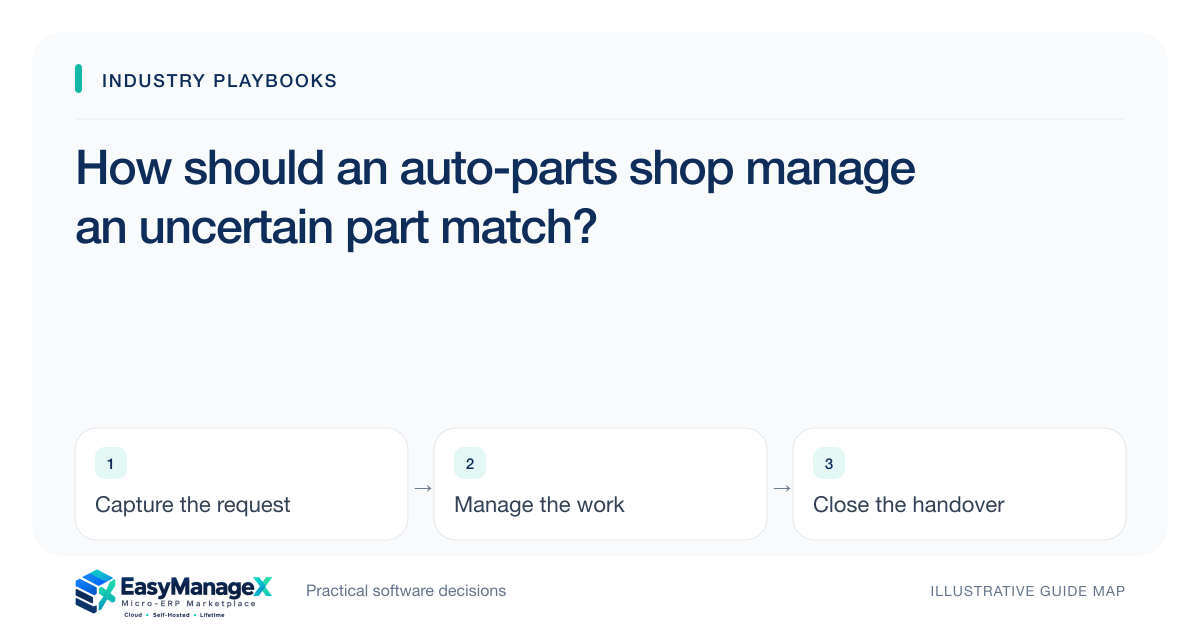
An uncertain auto-part match should remain an enquiry with recorded identification evidence and a responsible reviewer. Keep customer-provided references, supplier references and the confirmed order decision separate. Do not promise compatibility from a similar name or image; use the shop’s qualified reference process, then retain the decision basis when creating a reservation, special order or return case.
- Similar descriptions do not establish a confirmed part match.
- Preserve customer and supplier references separately.
- Special orders need an explicit reviewed decision.
Capture the identification question accurately
Record the customer’s requested part, supplied reference and relevant vehicle information permitted by your process. Distinguish verified details from uncertain statements. A familiar product description can hide differences that the counter employee is not authorised or qualified to resolve alone.
Use an enquiry identifier so photos, supplier responses and follow-up conversations remain connected. An uncertain request should not become a stock reservation merely because a user selected the closest-looking catalogue entry to complete the form.
Keep reference sources visible
Customer packaging, supplier information and the shop’s reference system may provide different identifiers. Retain the source of each reference and the responsible review outcome. Staff need to explain which evidence supported the decision rather than see a single part number with no origin.
Compatibility and technical suitability should follow the shop’s established process and appropriate qualified personnel. The operational record can document their decision without deriving a match from an image, a generic vehicle name or an illustrative catalogue listing.
Separate review from reservation and procurement
A reviewed match, a reserved unit and an approved special order are different states. Define which role moves the enquiry between them. If a supplier requires an order minimum or special terms, make those conditions visible to the authorised commercial owner.
Record the confirmed customer requirement and supplier reference when placing the order. A later substitution needs its own review. Silently changing the requested reference after procurement can leave the collection clerk unable to explain what the customer originally approved.
Illustrative scenario: two similar packaging references
Imagine a customer brings an old box with a partly readable reference. The counter identifies two similar supplier entries and records the uncertainty. A qualified reviewer obtains the relevant confirmation before an authorised owner places a special order against the confirmed reference.
The original box reference remains attached to the enquiry for collection and any follow-up. This illustrative scenario concerns evidence and ordering decisions; it does not establish vehicle compatibility, installation advice or entitlement to a return for a particular part.
Review receipt and customer handover separately
When the supplier delivery arrives, compare its identity with the recorded order reference. A received quantity does not prove that the item matches the approved request. Keep unexpected references in review before moving them into an ordinary collection or selling queue.
At handover, preserve the confirmed item and order reference along with the relevant customer communication. If a return later occurs, link it to the original enquiry and reviewed decision. This is more informative than correcting the old part number to resemble the returned packaging.
Evaluate an uncertain match end to end
Ask a demonstrator to retain two candidate references, record the authoritative review and create a special order. Introduce a supplier substitution at receipt. The system should keep the uncertain enquiry and confirmed order distinguishable without promising technical compatibility on its own.
EasyManageX product concepts are illustrative. Confirm reference fields, permissions and supplier exception handling with your own counter examples. A focused pilot should help staff route uncertainty to the appropriate person rather than encourage faster but unsupported part-selection promises.
Your working checklist
- Create stable enquiry identifiers.
- Label identification details by evidence source.
- Route uncertain matches to qualified reviewers.
- Separate reviewed matches from reservations and special orders.
- Check received references against approved orders.
- Test a supplier substitution before customer collection.
Common questions
Can a catalogue image confirm a match?+
An image can help identify an enquiry but should not substitute for the shop’s qualified reference process. Preserve the evidence source and review outcome. Avoid representing similar appearance or naming as proof of compatibility, particularly when the requested identifier is incomplete or uncertain.
What should happen to an unclear reference?+
Record the uncertainty and assign a reviewer who can obtain the appropriate confirmation. Keep candidate references linked to the enquiry without presenting either as final. Do not force an approximate part selection simply because the order screen requires a populated product field.
How do we handle a supplier substitution?+
Compare the supplied reference with the authorised order and route the difference through the appropriate review before handover. Preserve the original request, supplier response and decision. The operational record should explain the substitution rather than silently rewrite the requested part to match the received item.
Sources and further reading
These primary references explain relevant concepts. Our scenarios and working checklists are original, illustrative guidance.
- ERPNext documentation: Lead
Further reading on enquiry records and follow-up ownership; relevant to keeping uncertain part requests separate from confirmed order decisions.
Published by EasyManageX as practical, AI-assisted guidance. Examples are illustrative. Confirm software capabilities, licence terms and project-specific requirements before committing. Read our editorial policy.