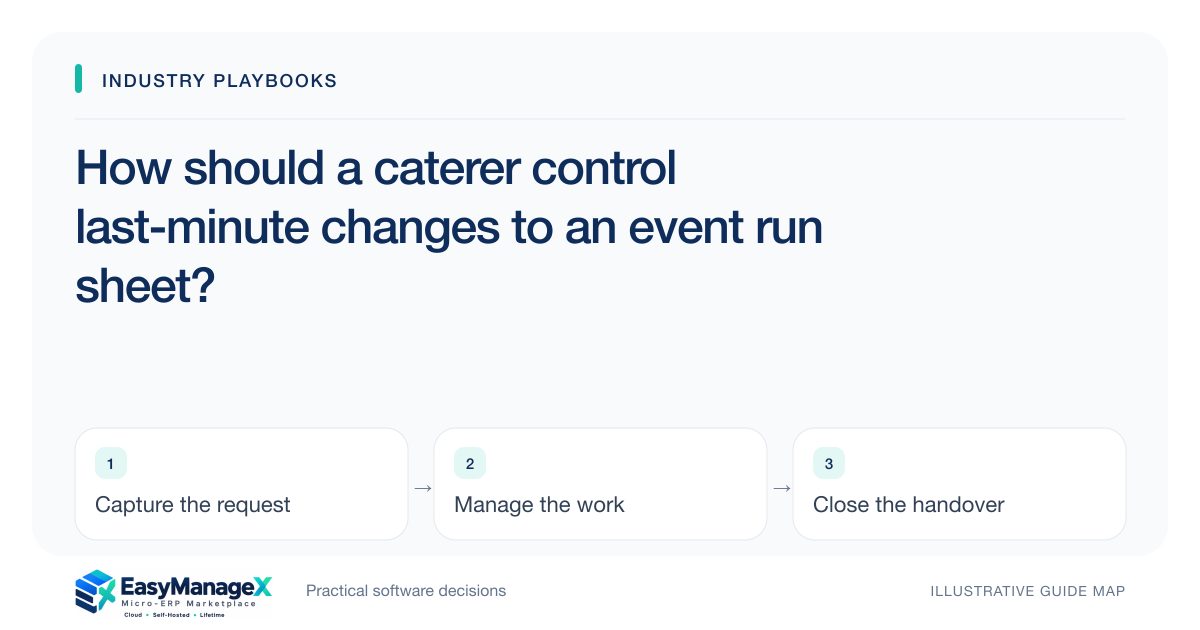
A catering run sheet should identify the confirmed event version and link preparation, dispatch and venue handoffs to it. Record headcount assumptions, service windows, equipment bundles and responsible leads. Late changes need an authorised review of their operational effects, followed by acknowledgement from affected teams, so a customer conversation does not silently rewrite work already underway.
- Every team needs the same confirmed event version.
- Late changes affect quantities, timing and equipment differently.
- Dispatch and venue handovers need separate acknowledgements.
Turn the event agreement into working references
Create one event identifier with venue, service windows, customer contact and the confirmed planning version. Distinguish agreed requirements from provisional estimates. Staff preparing quantities should be able to identify which headcount and service arrangement the authorised event lead has actually confirmed.
Break the run sheet into work that has owners: preparation, packing, transport, venue receipt and service setup. A beautiful document is not operationally complete if no one knows who acknowledges each bundle. Keep task references connected to the same event version.
Track quantities and equipment separately
Preparation quantities and equipment requirements respond differently to an event change. An added table may require more place settings or service equipment without changing every food quantity. Record these categories distinctly so the lead can review the practical effect rather than apply a blanket percentage increase.
Use the caterer’s established procedures and qualified personnel for food handling and related technical decisions. The run sheet should communicate confirmed requirements and responsibilities; it should not prescribe a food-safety method or substitute for the team’s approved preparation and service procedures.
Require acknowledgement of late changes
A late request should identify the proposed change, requester and affected event version. The event lead reviews feasibility, records the authorised outcome and assigns communications to the relevant teams. A message in a customer conversation is a request until that operational decision is complete.
Track which preparation, dispatch and venue leads acknowledged the approved change. If one team has already left, name the person responsible for its update. Merely editing a shared document can leave a printed packing list and the venue team working from different versions.
Illustrative scenario: an extra service area is added
Imagine a venue asks for a second service area shortly before dispatch. The event lead checks equipment bundles, staffing assignments and transport space. The approved run-sheet revision adds a named setup task and an updated equipment list rather than changing only the venue notes.
Dispatch acknowledges the revised bundle, and the venue lead confirms receipt on arrival. This illustrative scenario addresses event coordination; it does not establish a guaranteed service outcome, a food-handling procedure or a commercial entitlement for a late request.
Close the event through return and exception records
An event is not fully reconciled when the vehicle leaves the venue. Record returned equipment, missing items and unresolved customer or supplier discussions against the event identifier. A named closing owner can then follow up without asking every team to reconstruct its part from memory.
Preserve variations and handover evidence during review. Compare planned and actual movements using the agreed references. This helps the caterer identify whether a problem arose in planning, packing, transport or venue coordination rather than attributing every discrepancy to the final service team.
Evaluate with two versions in circulation
Ask a demonstrator to approve a late change after one team has printed its instructions. Require acknowledgement, revise an equipment bundle and record a partial venue receipt. Inspect whether the outstanding handoff remains visible to the event lead.
EasyManageX listings are illustrative. Confirm version control, task ownership and equipment movement with your own event structure. A focused pilot on one event format can reveal the fields staff genuinely need before a complicated run sheet is extended across every type of booking.
Your working checklist
- Create event identifiers and confirmed version numbers.
- Separate estimates from authorised requirements.
- Assign preparation, dispatch and venue leads.
- Review late changes for quantity and equipment effects.
- Track acknowledgements from affected teams.
- Reconcile returned equipment and unresolved exceptions.
Common questions
Should customer messages directly update the run sheet?+
Use messages to capture proposed changes, then require the authorised event owner to confirm the operational outcome. Keep the request and resulting revision linked. This prevents an informal conversation from silently changing preparation, transport or venue instructions that another team has already accepted.
What belongs on a dispatch bundle record?+
Include the event reference, destination, planned handover window, contents and receiving owner. Record partial or disputed receipt separately from departure. The exact fields should match your packing process, with enough information for the venue lead to identify what was actually delivered.
How do we handle missing equipment after an event?+
Create an event-linked exception with item identity, expected return, last acknowledged handover and follow-up owner. Preserve observations without assigning blame prematurely. Review the movement sequence and record the authorised resolution, so future availability does not depend on an unexplained adjustment.
Sources and further reading
These primary references explain relevant concepts. Our scenarios and working checklists are original, illustrative guidance.
- ERPNext documentation: Project
Further reading on project tasks and customer handoffs; relevant to organising catering preparation, dispatch and venue responsibilities.
Published by EasyManageX as practical, AI-assisted guidance. Examples are illustrative. Confirm software capabilities, licence terms and project-specific requirements before committing. Read our editorial policy.