An integration needs an agreed owner for each record, a stable identifier and a defined response to delay, duplication and failure. Start with the business handoff, then verify the connector or API can support it. Include monitoring, reconciliation and ongoing credentials in the estimate; a connection demonstration is only the beginning.
- Assign a source of truth for each shared field.
- Test duplicates, delays and cancelled transactions.
- Include operating ownership and maintenance in the integration scope.
Describe the business handoff
Write what crosses the boundary, why and when. An approved order sent to dispatch is different from a real-time bidirectional stock sync. Specify completion evidence: the receiving system should acknowledge the intended record, not merely return a successful connection message during setup.
Identify what remains manual and who owns it. An integration may automate creation while exceptions still need a person. Make those exceptions visible in the proposal. Hidden manual work often becomes the largest operational burden when transaction volume rises or multiple teams believe someone else is responsible.
Choose record ownership
For each shared entity, decide which system creates it and which fields it controls. Customer contact details may originate in CRM while stock availability comes from the inventory system. Define whether a downstream edit is prohibited, overwritten or intentionally synchronized; otherwise users can create conflicting versions.
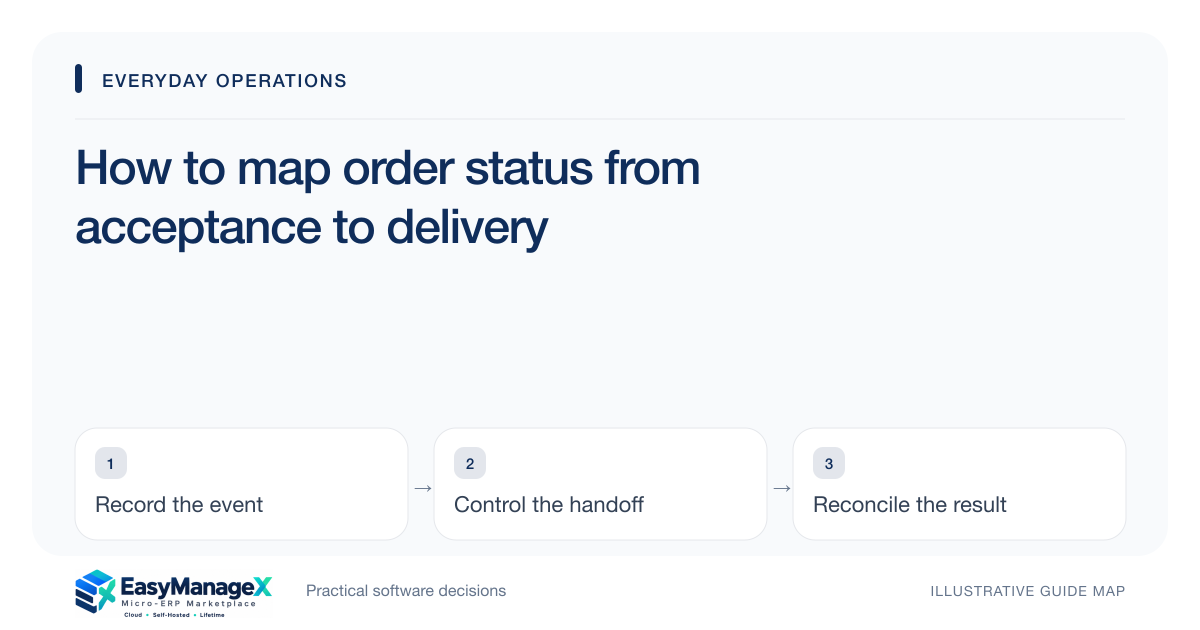
Use stable identifiers and document mappings. Names, email addresses and item descriptions can change, so they are weak reconciliation keys. Include status mappings and units of measure. A technically valid message can still create a business error when one system treats a cancelled order as open.
Specify failure behavior
Ask what happens when the receiving service is unavailable, returns a validation error or acknowledges slowly. Define retries and duplicate prevention using the actual platform’s supported mechanisms. The operating design should distinguish a message not sent, a message sent without acknowledgement and a record rejected downstream.
Require a visible exception queue or another documented way to detect and resolve failures. Confirm who can safely resend or correct records. A retry button without clear record state can duplicate orders, while an invisible background failure can leave staff believing the handoff completed successfully.
Use an illustrative order sync
Illustrative scenario: an online order flows into a fulfilment tool. The response is delayed after the fulfilment record has already been created. A trial resends the same order reference and checks whether the second attempt is recognized rather than creating another dispatch task.
The team then cancels the order before dispatch and observes both systems. This reveals whether the integration handles business changes beyond initial creation. The scenario does not presume a particular connector has duplicate protection; that behavior must be demonstrated and included in the accepted scope.
Check access and lifecycle costs
Identify the accounts and permissions the integration uses. Avoid unnecessary broad access, and clarify token rotation, account departure and troubleshooting procedures. Use authorized test environments for verification. A connector that works through a personal administrator account creates a continuity problem even when its normal data transfer looks correct.
Price setup, provider subscriptions, usage charges, monitoring and future compatibility work separately. Ask who maintains the interface when either application changes. Record supported versions and limits; an API being available does not establish that a quoted connector remains reliable under your expected volume and workflow.
Reconcile before expanding
Define a simple reconciliation report using record counts, identifiers and important totals. Review unmatched or delayed records at an agreed cadence. Monitoring technical errors and reconciling business results serve different purposes; both may be necessary where a failed handoff affects fulfilment or customer communication.
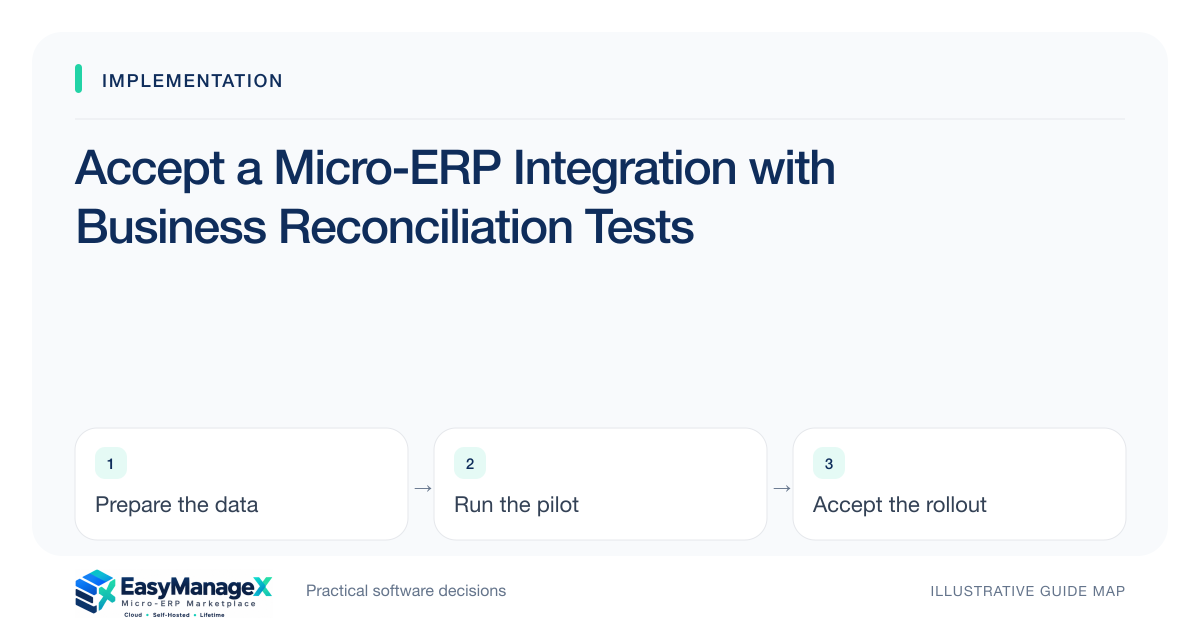
Begin with a narrow, observable exchange and expand after normal and failure cases pass. EasyManageX solution descriptions can guide the handoffs to investigate, but catalogue entries are illustrative. Require candidate-specific integration evidence and name the team that owns operation after the initial developer finishes.
Your working checklist
- Write the exact business handoff.
- Assign field and record ownership.
- Document identifiers and status mappings.
- Test a delayed acknowledgement.
- Test cancellation and duplicate prevention.
- Assign credential and exception owners.
- Define reconciliation and maintenance costs.
Common questions
Does API access mean integration will be easy?+
It provides a technical interface, but implementation still depends on supported operations, permissions, identifiers, limits and error handling. Ask for a worked scenario and costed scope. An API may expose records without supporting the status changes or reconciliation your business process requires.
Should integrations synchronize in both directions?+
Only where the workflow needs it and conflict rules are clear. One-way exchange can be simpler when one system owns the record. If both sides can edit, specify which fields each controls and how conflicts resolve before introducing automated updates to live data.
What should a successful integration test prove?+
It should prove the normal handoff, relationship mapping, expected timing and recovery from important failures. Include duplication, rejection and cancellation when relevant. Verify downstream business state and reconciliation, not just an HTTP response or connector status indicator that says the applications are connected.
Sources and further reading
These primary references explain relevant concepts. Our scenarios and working checklists are original, illustrative guidance.
- OWASP Authorization Cheat Sheet
Least privilege, deny by default and permission verification.
- OWASP Logging Cheat Sheet
Audit event design and sensitive data exclusions.
Published by EasyManageX as practical, AI-assisted guidance. Examples are illustrative. Confirm software capabilities, licence terms and project-specific requirements before committing. Read our editorial policy.