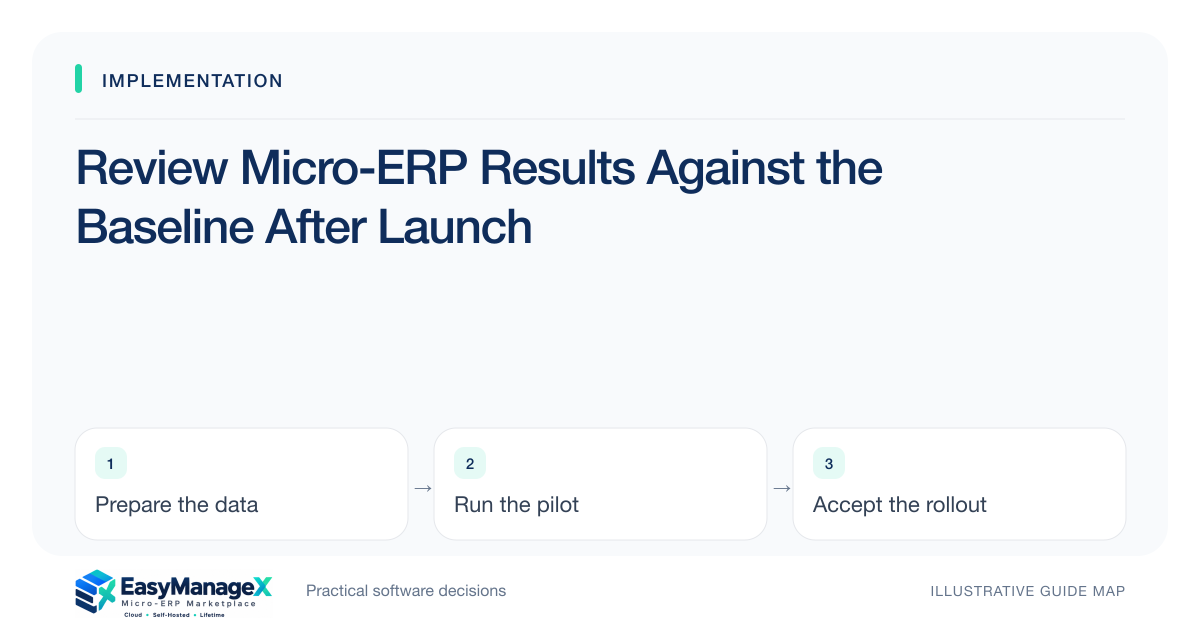
A post-launch review compares agreed operational outcomes with the pre-launch baseline under comparable conditions. Examine workflow completion, exceptions, data quality, support effort and ongoing costs. Separate adoption effects from configuration or product limitations, then prioritize specific changes. Do not claim improvement from activity counts alone or invent conversion, revenue or productivity gains without evidence.
- Compare equivalent workflows and operating periods.
- Measure exceptions and ownership effort beside activity.
- Turn findings into prioritized, testable changes.
Return to the original problem
Read the scope statement and baseline that justified the project. Identify the handoff or inconsistency the workflow was meant to improve. This keeps the review focused on business outcomes rather than how many users logged in or how attractive the new dashboard looks compared with old screens.
Confirm whether the process or workload changed substantially during implementation. A new branch, product mix or staffing change can affect comparisons. Document those differences honestly. The review should explain evidence and limits rather than force every observed change into a success story about the application.
Choose comparable measures
Use measures with clear definitions, such as time from approved order to dispatch confirmation, unresolved exception count or duplicate customer creation. Compare similar periods and record sources. Avoid relying on averages alone when a few long delays or high-impact errors matter more to the workflow than the typical case.
Keep local observations separate from general claims. A measured improvement in one team does not establish a universal percentage for other businesses. Do not present illustrative examples as customer results. Where records are incomplete, describe the gap and collect a better baseline for future review.
Examine actual task behavior
Observe users completing normal work and exceptions. Ask which steps remain manual, confusing or repeatedly corrected. Distinguish a configuration issue from a training gap and from an accepted product limitation. The response should address the cause rather than adding another dashboard or repeating the same orientation session for everyone.
Check whether off-system work has grown. Staff may quietly rebuild spreadsheets when required reports or corrections remain difficult. Understand why before removing the workaround. It can reveal a missed requirement or unclear ownership, and may need a controlled integration or process change instead of a blanket prohibition.
Work an illustrative review
Illustrative scenario: an agency compares task handover after introducing a shared project workflow. Assignment is faster, but overdue items remain unclear because users apply two status meanings differently. The team reviews the dictionary and updates training and one report filter before claiming that the original coordination problem is solved.
The scenario contains no invented customer result or productivity percentage. Its value lies in identifying the mechanism behind mixed evidence. A project can improve one step while leaving another bottleneck in place; a useful review makes that visible and assigns a specific next action.
Include ownership and cost
Review actual support hours, administrative work, provider charges and integration maintenance against the planning worksheet. Explain significant differences and whether they are temporary launch effects or ongoing requirements. A workflow improvement can still require a budget adjustment if its operating responsibilities were underestimated during selection.
Check account ownership, data quality and recovery procedures as part of sustainability. If administrators cannot perform routine reviews or the team has not maintained new reference records consistently, expansion may worsen the problem. Resolve those responsibilities before treating growth as the automatic next phase.
Prioritize evidence-based improvements
Choose a small set of changes with a clear problem, expected result, owner and acceptance test. Use the change process to evaluate cost, permissions and retesting. Preserve successful behavior while addressing verified gaps; avoid reopening every design preference merely because the implementation has reached a review meeting.
Record what passed, what improved, what remains uncertain and what requires action. EasyManageX categories and guidance can structure further discovery, but illustrative catalogue listings do not establish performance outcomes. Your organization’s observed results and operating capacity should determine the next investment or rollout stage.
Your working checklist
- Revisit the original scope and baseline.
- Align measure definitions and periods.
- Record workload changes and evidence limits.
- Observe normal and exception tasks.
- Investigate off-system work.
- Compare actual ownership and cost.
- Prioritize changes with acceptance tests.
Common questions
When should the post-launch review happen?+
Choose a point after users have enough operating experience to produce meaningful evidence, while still allowing timely correction of important issues. Review critical risks sooner. The right timing depends on workflow frequency, seasonality and launch changes; a calendar date alone cannot ensure a representative comparison.
Do more logins prove better adoption?+
They show activity, but not that users can complete the intended work or obtain correct results. Combine usage information with task observation, completion evidence and exception trends. Users may log in frequently because a process is difficult, so activity needs context before it supports an improvement claim.
What if the project did not meet its original goal?+
State the evidence plainly and identify the cause, limitations and available options. Separate training, configuration, data and product gaps, then prioritize testable actions with owners and costs. A transparent review is more useful than inventing gains or expanding the system before the essential problem is understood.
Sources and further reading
These primary references explain relevant concepts. Our scenarios and working checklists are original, illustrative guidance.
- IBM: What is enterprise resource planning?
ERP integration and shared operational data; vendor-neutral original guidance in our articles.
- AWS Well-Architected Cost Optimization Pillar
Cost ownership and measuring resource spending, not ERP price benchmarks.
- OWASP Logging Cheat Sheet
Audit event design and sensitive data exclusions.
Published by EasyManageX as practical, AI-assisted guidance. Examples are illustrative. Confirm software capabilities, licence terms and project-specific requirements before committing. Read our editorial policy.