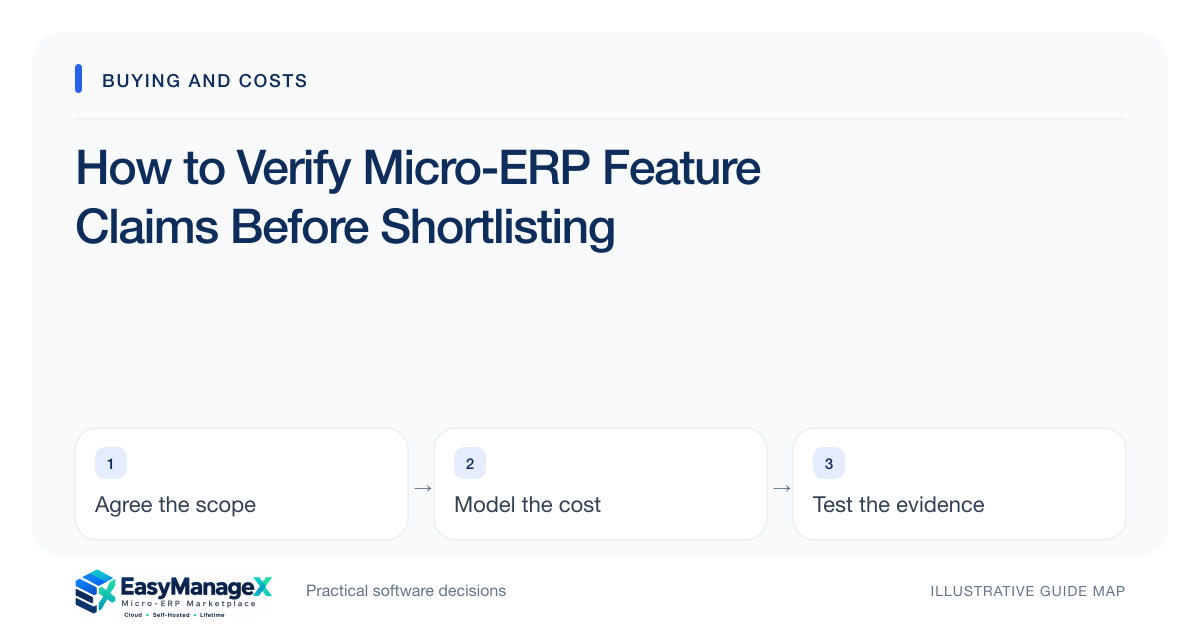
Verify a feature by observing the behavior your workflow needs in the relevant product edition and deployment. Ask what is native, configured, integrated or custom, then test normal and exception cases with your records. Treat catalogue descriptions and planned features as discovery information until concrete evidence establishes fit and availability.
- Translate broad feature names into observable behavior.
- Check the exact edition and deployment being shown.
- Keep future promises separate from demonstrated capabilities.
Translate labels into outcomes
A label such as inventory, approvals or reporting covers many possible behaviors. Rewrite it as a task: show available stock for a location, prevent approval by the requester, or export a reconciled month-end total. The task gives you something useful to observe and compare.
Include the required inputs and outputs. An inventory screen may count on-hand units but ignore reserved quantities; a report may look correct while using a different status filter. Precise definitions prevent two vendors from answering yes to the same word while proposing substantially different workflows.
Check the capability’s route
Ask whether the behavior exists in the quoted product, requires configuration, uses an external connector or needs development. Request dependencies and ownership for each route. A custom solution may be appropriate, but its delivery estimate and maintenance effort should remain visible in the comparison.
Confirm the edition, version and deployment shown in demonstrations. Features can differ between hosted and self-hosted variants or between pricing tiers. Record the environment beside your evidence so later discussions do not accidentally treat a premium demonstration as proof about a narrower offer.
Test both success and limits
Have the candidate complete one ordinary transaction and one important exception. For permissions, test a rejected action; for imports, test an invalid row; for reports, test a known boundary date. These checks reveal whether the feature can support the process rather than merely display a screen.
Ask about volume and rate boundaries relevant to your workload. Do not manufacture an extreme test unrelated to the purchase. If a limit is documented but not demonstrated, record its source and whether additional validation is required before launch at the expected operating scale.
Use an illustrative export claim
Illustrative scenario: a project agency needs to move client tasks and attachments into an archive. A candidate claims export support. The trial reveals that its export contains task titles and dates, but lacks attachment files and the client identifiers needed to reconnect related records.
The agency changes the requirement from export available to usable project archive with stable relationships. It requests a sample containing two clients with similar names and one corrected task. This sharper requirement improves comparison without assuming any particular provider lacks or supplies the needed behavior.
Distinguish plans from present evidence
Roadmap items, sales assurances and proposed customization are different from functionality observed today. Give each a clear status and request a delivery condition if it is essential. Never enter a planned item in the demonstrated column simply because the seller sounds confident about future availability.
Review supporting documents for dates and applicability. Screenshots, release notes and technical documentation can establish context, but essential behaviors still deserve a trial where possible. EasyManageX catalogue products are illustrative references; neither listing presence nor a feature phrase establishes that a purchase-ready implementation exists.
Keep a compact evidence register
Record requirement, candidate, evidence type, environment, result, limitation and follow-up owner. Link the evidence to scope and cost discussions. The register need not be elaborate: its value comes from making uncertainty explicit before the team commits money or reorganizes a critical process.
Recheck important claims during implementation acceptance using your configured environment and normal user accounts. A demonstration may prove feasibility, while acceptance must prove delivered behavior. Carry unresolved dependencies into the rollout plan so they receive owners and decisions instead of disappearing after selection.
Your working checklist
- Rewrite feature labels as user tasks.
- Identify the offered edition and version.
- Separate native and custom behavior.
- Test one meaningful exception.
- Inspect outputs and relationships.
- Record limits and evidence status.
- Recheck essential claims during acceptance.
Common questions
Is official documentation enough to prove a feature?+
Documentation is valuable evidence of intended behavior and supported scope. It may not establish that your edition, configuration or integration meets a specific workflow. For essential requirements, combine current documentation with a representative demonstration or trial and record dependencies that still require confirmation.
How should roadmap features affect a shortlist?+
Treat them as unavailable until the delivery commitment and acceptance conditions are suitable for your purchase. A candidate may remain on the shortlist if the workflow can proceed without the planned feature. Keep proposed future functionality out of the current demonstrated-capability score.
Should I reject every workaround?+
No. A simple, documented workaround can be acceptable when its effort and risks fit the workflow. Ask users to perform it, estimate how often it occurs and assign ownership. Repeated manual corrections or undocumented administrator steps deserve more scrutiny than an occasional transparent exception.
Sources and further reading
These primary references explain relevant concepts. Our scenarios and working checklists are original, illustrative guidance.
- IBM: What is enterprise resource planning?
ERP integration and shared operational data; vendor-neutral original guidance in our articles.
- OWASP Authorization Cheat Sheet
Least privilege, deny by default and permission verification.
Published by EasyManageX as practical, AI-assisted guidance. Examples are illustrative. Confirm software capabilities, licence terms and project-specific requirements before committing. Read our editorial policy.