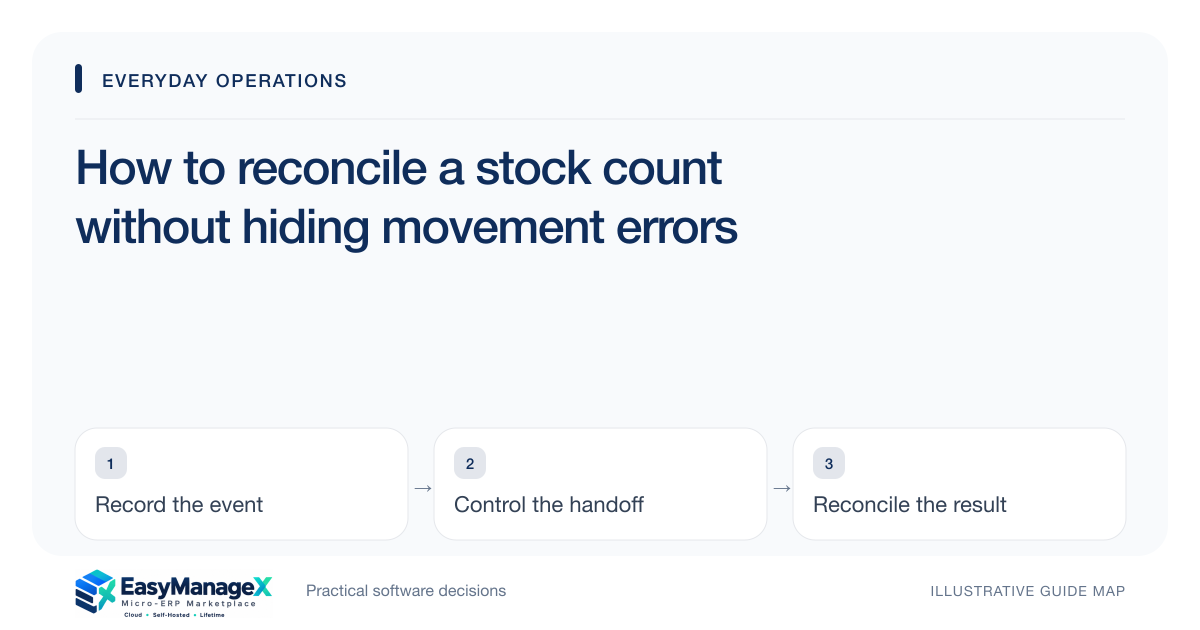
Stock reconciliation compares a defined physical count with the ledger at a matching time and scope. Plan the count boundary, control or account for movements, investigate differences and approve justified corrections. Preserve the original expected balance and evidence. Replacing the balance with a counted number can restore agreement while concealing the process that created the discrepancy.
- Match the count and ledger by location, unit and cutoff.
- Investigate significant differences before adjustment.
- Retain count evidence and correction reasons.
Choose a manageable counting scope
Define the locations, items, units and stock states included. Countable physical stock and available-to-sell stock are not identical when reservations or holds exist. State the comparison clearly so counters and reviewers know which quantity they are verifying.
Select a manageable scope for the available staff and time. A focused cycle count can be useful when a complete closure is impractical. The important requirement is that the selected population and counting procedure are repeatable and understandable.
Set the movement boundary
Freeze movements where practical or record every relevant movement during the count. Establish a cutoff time and capture the ledger snapshot used for comparison. An item dispatched between its physical count and ledger review can create a false discrepancy.
Explain how receiving, picking and transfers operate during the exercise. Staff need specific instructions for goods arriving or leaving a counted area. A general announcement that counting is underway does not tell them which movements require a separate record.
Check identity and units before recounting
Confirm that the physical item matches the ledger identity, including variant or batch where relevant. Check carton-to-unit conversions and location assignments. A large difference may result from comparing different identities rather than from missing goods.
Use a recount or independent review for differences that meet your chosen criteria. Document the observed count and method. Repeating the same mistaken assumption with the same counter is less useful than checking the identity, location and unit systematically.
Illustrative scenario: cartons and individual units
An illustrative parts warehouse counts six cartons of an item recorded in individual units. The first comparison reports a shortage because the count was entered as six units. The reviewer checks the packaging and documented conversion before authorising any adjustment.
A separate discrepancy remains after conversion: a transfer was dispatched before the cutoff but not received at the destination. The team resolves the linked transfer records rather than making unrelated adjustments in both locations. Each difference receives the correction appropriate to its cause.
Approve a correction with its explanation
A correction should reference the count, expected quantity, verified result and reason. Name the preparer and reviewer where your policy requires separation. Preserve the original comparison so later staff can understand why the ledger changed.
Do not use an adjustment to settle a supplier or customer dispute without reviewing the related transaction. Inventory quantity and commercial resolution may require different records. Keep outstanding issues visible when the physical count can be corrected before the broader dispute is resolved.
Use differences to improve recording
Group reviewed discrepancies by meaningful cause, such as unit confusion, delayed transfer or unrecorded damage. Assign a practical improvement to the recurring cause. A repeated count adjustment without process follow-up can make accuracy temporary and reconciliation increasingly routine.
Use a sample discrepancy to test the full path from count evidence to corrected balance and follow-up action. Reviewers should identify the comparison cutoff and original transaction references. Confirm that the selected implementation preserves that evidence instead of treating a new stock total as sufficient explanation of the correction.
Your working checklist
- Define items, locations and units in scope.
- Capture the comparison cutoff and ledger snapshot.
- Control movements during the count.
- Verify identity and conversion factors.
- Recount according to documented criteria.
- Approve corrections with linked evidence.
Common questions
Must the warehouse stop all work during a count?+
Not always. A freeze simplifies the comparison, but some operations must continue. In that case, record and reconcile movements against the count boundary carefully. The chosen method should allow the reviewer to explain whether a difference reflects physical stock, timing or incomplete transaction recording.
Should every stock difference become an adjustment?+
Investigate the cause first. A missing receipt, incorrect unit or unfinished transfer may need correction of its original transaction. An attributable adjustment is appropriate when your reviewed evidence supports it. Using adjustments for every difference can conceal recurring workflow failures and make transaction history harder to interpret.
How can cycle counting help a small warehouse?+
It lets a team verify a defined subset of stock without attempting a complete count every time. Choose scope and cadence based on operational needs, then keep the method consistent. Cycle counting is most useful when discrepancies lead to reviewed corrections and improvements in the recording process.
Sources and further reading
These primary references explain relevant concepts. Our scenarios and working checklists are original, illustrative guidance.
- ERPNext documentation: Stock Reconciliation
Further reading on count-based stock reconciliation and opening balances.
- Microsoft Learn: Inventory on-hand list
Further reading on inventory dimensions and available quantities.
Published by EasyManageX as practical, AI-assisted guidance. Examples are illustrative. Confirm software capabilities, licence terms and project-specific requirements before committing. Read our editorial policy.