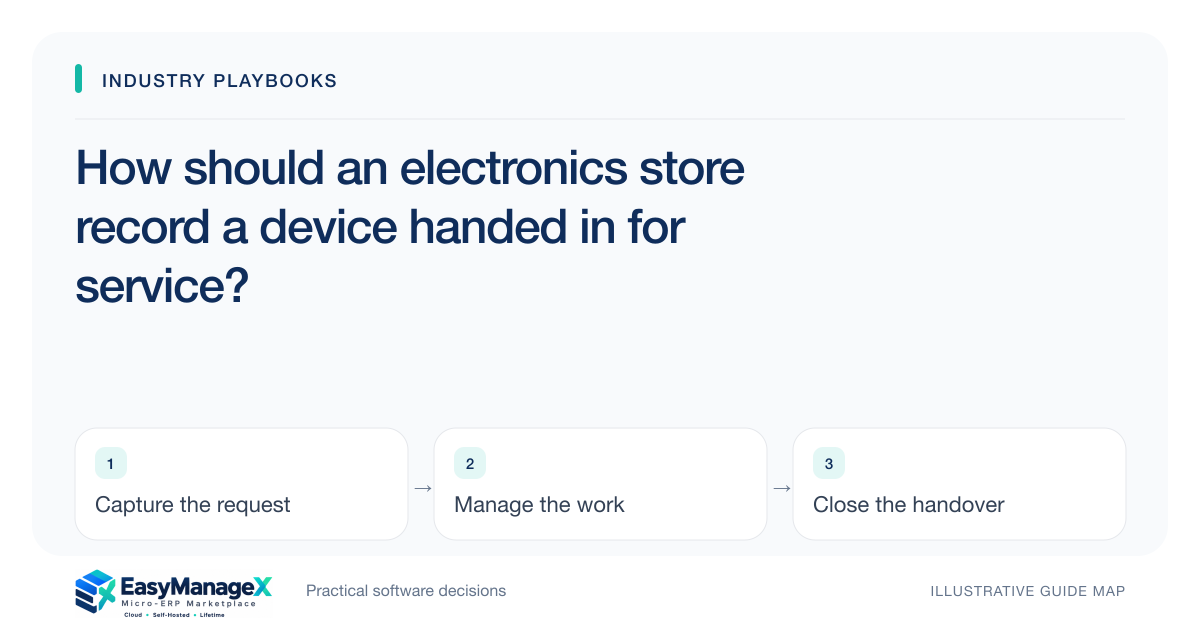
Electronics service intake should identify the physical device and what arrived with it before anyone discusses an outcome. Record the serial number when available, visible condition, accessories, customer complaint and custody location. Keep service assessment and commercial approval separate, and verify the device identity again when handing it back to the customer.
- Identify the device separately from the customer complaint.
- Record accessories and every custody transfer.
- Treat assessment and repair approval as separate decisions.
Capture the physical handover carefully
At intake, record product type, model, available serial number and the accessories received. Staff should describe visible condition using agreed categories and plain observations. Do not let an assumed diagnosis replace the customer’s own explanation of the problem or the record of what was handed over.
A missing or unreadable serial number needs an explicit identity exception. Use an intake reference and a physical label while a responsible person reviews it. Avoid copying a serial number from an unrelated sale simply because the customer bought a similar device at the shop.
Keep customer instructions within the right scope
Record the reported symptom, contact preference and any restrictions the customer communicates. Explain the next assessment step through the store’s established service process. Intake staff should not promise a repair outcome, coverage decision or completion date before the responsible service owner has reviewed the device.
Devices may contain personal information. Collect only the information necessary for the intake process, and define who may access customer instructions or attachments. Any access to device content needs the business’s applicable procedures and qualified guidance; a service record should not become an unrestricted repository of private data.
Track custody and location independently
A service status such as assessed or waiting for approval does not say where the device is. Maintain location, current custodian and handover time separately. If a device moves to another service provider, retain the dispatch reference and the expected return contact.
Accessories need the same attention as the main device. A charger or detachable component can be separated during assessment. Label the bundle and record changes to its contents so the person completing collection can verify what must be returned without relying on the memory of the intake clerk.
Illustrative scenario: a laptop without its charger
Consider a customer bringing a laptop with an intermittent problem but no charger. The clerk records the missing accessory and the available serial number, then assigns a labelled service location. A technician later requests assessment approval before performing work beyond the agreed intake step.
When the device returns to the counter, staff compare the serial number and bundle contents with the intake record. This illustrative scenario shows a custody and communication workflow; it does not promise diagnosis, repair success or warranty eligibility from any listed product concept.
Record approval and changes visibly
An assessment can produce a proposed next step that requires customer or internal approval. Record the proposal reference, authorised scope, approving person and response date. If the scope changes later, preserve the earlier decision and the new approval instead of silently replacing the original instruction.
Keep waiting cases in a queue with named ownership. A device awaiting customer response needs a different follow-up from a device awaiting an external provider. Distinguishing the reason for waiting helps staff give an accurate update rather than repeating an unsupported completion estimate.
Evaluate the complete collection process
A useful demonstration follows one device from intake through an identity exception, accessory transfer, assessment approval and collection. Ask who can see private notes and whether the final handover compares serial and bundle contents. Include a customer who changes the approved scope.
EasyManageX catalogue entries are illustrative, so request evidence for custody, permissions and approval history. Your brief should describe the actual devices and service partners involved. Service status labels alone do not prove that a customer’s property can be located and returned with the correct documented accessories.
Your working checklist
- Define intake fields for model and serial identity.
- Record accessories and observed condition.
- Label devices with their intake references.
- Separate assessment proposals from approved service scope.
- Assign custody locations and handover owners.
- Test collection against serial and bundle contents.
Common questions
What if the serial number is unreadable?+
Create a clearly marked identity exception with an intake reference and physical label. Assign review to a responsible person rather than guessing from purchase history. Keep the customer’s description and observed device details available so the next handoff can recognise the unresolved identification problem.
Should we collect passwords at the counter?+
Do not add sensitive access details to a general intake record by default. Determine what the service process actually requires and follow the business’s privacy and access procedures with qualified guidance. Restrict any necessary information to authorised personnel and define its handling and removal process.
Can the intake record establish warranty coverage?+
The record can preserve purchase references, device identity and customer statements for a coverage review. It should not manufacture an eligibility decision. Record the responsible party’s assessment and its basis separately, so counter staff communicate the confirmed outcome rather than an assumption made during handover.
Sources and further reading
These primary references explain relevant concepts. Our scenarios and working checklists are original, illustrative guidance.
- OWASP Authorization Cheat Sheet
Access-control principles for limiting device-service notes and supporting material to the personnel who need them.
Published by EasyManageX as practical, AI-assisted guidance. Examples are illustrative. Confirm software capabilities, licence terms and project-specific requirements before committing. Read our editorial policy.