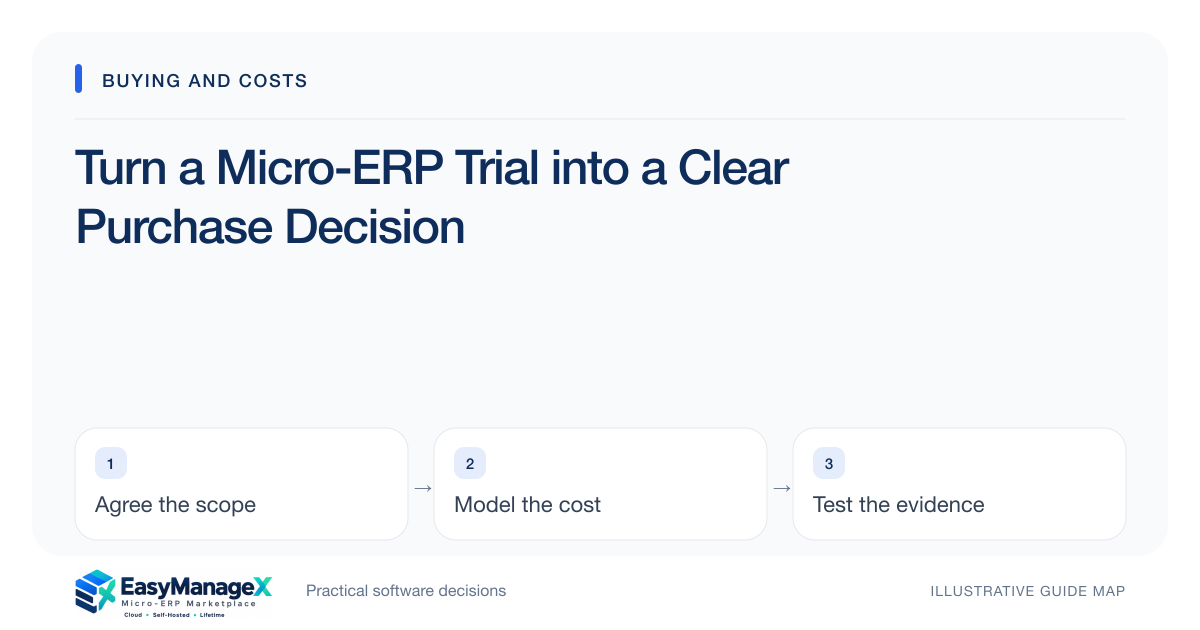
A trial should resolve specific buying questions with representative users and records. Define the essential tasks, exceptions, evidence and decision date before starting. Evaluate workflow fit, operating ownership and data access alongside usability. Advance when essential conditions pass and remaining limitations have accepted owners, costs and workarounds.
- Choose a few unresolved questions the trial can answer.
- Use normal user accounts and realistic sanitized records.
- Record pass, fail and unresolved separately.
Choose the questions to resolve
Identify what remains uncertain after initial demos: partial receipts, branch access, export relationships or operator usability. A trial without those questions can become aimless browsing. Limit the scope to decision-critical workflows that your team has time to perform and interpret properly.
Ask what the trial environment includes and what differs from the intended offer. Sample data, premium modules or temporary assistance may make tasks easier than production will be. Record the version, configuration and paid dependencies so evidence remains relevant to the candidate’s actual proposal.
Recruit representative operators
Include people who perform the process, a reviewer and the person who will administer it. Their observations answer different questions. A manager may understand reporting needs while a checkout operator notices an awkward correction step. Give each participant concrete tasks rather than asking whether the application feels good.
Use normal role accounts and representative devices. Test keyboard operation or mobile use where relevant, without assuming a small-screen layout is sufficient for every job. Capture observed difficulties and the step where they occurred, distinguishing unfamiliarity that training can address from an unsuitable workflow.
Prepare a controlled dataset
Create a small linked dataset with known totals and intentional exceptions. Include similar names, cancelled records and a corrected transaction where appropriate. Sanitize sensitive information and confirm who can access the environment. The goal is representative structure, not a copy of every live business record.
Keep expected results beside the scenarios. If the trial includes stock receiving, calculate the intended quantities beforehand. This lets the team detect a wrong result instead of admiring a plausible report. Known reference records also make later implementation testing more efficient and comparable.
Use an illustrative trial week
Illustrative scenario: a workshop tests booking, job assignment, parts usage and closure with three operators. One scenario changes an appointment after parts have been reserved; another closes a job with unused parts. The trial must explain both the customer status and the inventory result.
At the review, operators identify an acceptable extra confirmation step but an unresolved parts reversal. The team advances only after the reversal is demonstrated or an explicitly accepted process addresses it. A smooth login and attractive job board do not override the essential reconciliation question.
Record results while they happen
Use pass, fail, partial and untested statuses with evidence. Write the account role, scenario and actual result. Avoid turning memory or enthusiasm into a score several days later. If assistance was needed, document what the helper did and whether that assistance belongs in the purchased implementation.
Estimate recurring workaround effort using expected frequency. A one-off administrator correction may be acceptable during setup but unsuitable for daily use. Keep training, configuration and product limitations separate so each receives the right follow-up rather than treating every obstacle as something users must simply learn.
Make a bounded decision
Review essential gates, unresolved dependencies, operating responsibilities and complete costs. Decide to advance, extend for a specific question or stop. An extension should have a defined purpose and end date; repeated unstructured trials can consume staff time without reducing uncertainty or improving the decision.
Carry trial evidence into the implementation plan and retest in the delivered environment. EasyManageX categories help organize discovery, while illustrative listings do not prove a candidate’s availability. The purchase decision should rest on confirmed supplier details and demonstrated behavior for the scope your organization actually needs.
Your working checklist
- Name unresolved buying questions.
- Confirm trial edition and limitations.
- Recruit representative operators.
- Prepare linked sanitized records.
- Write expected scenario results.
- Capture evidence and assistance.
- Set a decision gate and date.
Common questions
How much data should a trial use?+
Use enough linked records to exercise the essential workflow and its important exceptions. A full historical import is usually unnecessary at this stage. Known expected results matter more than volume, although performance-sensitive workflows may also require a separately planned and authorized representative-volume test.
Can training issues make a trial fail unfairly?+
They can, so provide reasonable orientation and distinguish learnable navigation from a workflow limitation. Record whether users can complete tasks after guidance and what recurring effort remains. Do not assume every difficulty is a defect, but do not dismiss repeated confusing corrections as unfamiliarity without evidence.
When should we extend a trial?+
Extend it when a specific essential question remains unresolved and there is a realistic plan to obtain evidence. State the task, owner and deadline. If the candidate repeatedly cannot demonstrate required behavior, continued browsing may add little value compared with considering another approach.
Sources and further reading
These primary references explain relevant concepts. Our scenarios and working checklists are original, illustrative guidance.
- IBM: What is enterprise resource planning?
ERP integration and shared operational data; vendor-neutral original guidance in our articles.
- W3C Web Content Accessibility Guidelines 2.2
Accessible forms and interfaces; no conformance certification implied.
Published by EasyManageX as practical, AI-assisted guidance. Examples are illustrative. Confirm software capabilities, licence terms and project-specific requirements before committing. Read our editorial policy.