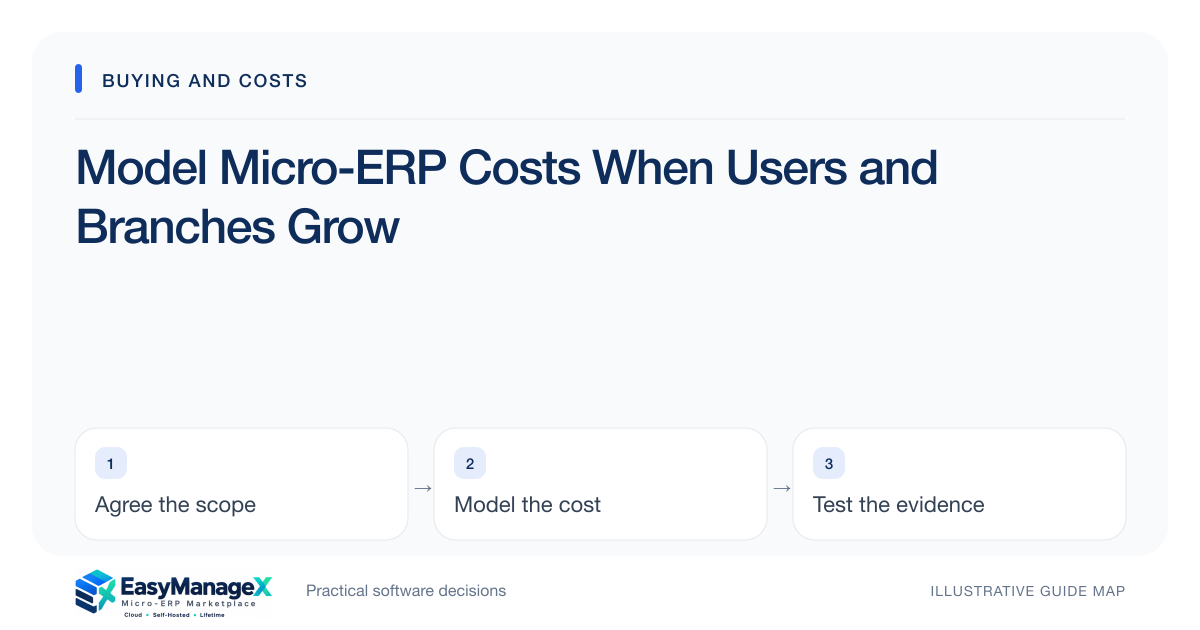
Growth cost depends on the actual pricing unit and the work required to add capacity, locations and users. Model your current workload and one plausible expansion using identical assumptions across candidates. Include training, permissions, migration and support, then clarify thresholds in writing rather than assuming today’s quoted price scales proportionally.
- Identify the pricing unit before forecasting growth.
- Include branch setup and operational work beside licences.
- Label future workload assumptions and pricing uncertainties.
Identify what the price measures
Ask whether charges follow named users, concurrent users, branches, organizations, records, transactions or storage. Definitions matter: a read-only supervisor and a daily operator may be priced differently, and an inactive account may still count. Obtain the applicable unit definitions from the actual proposal.
Write which employees need which functions. Avoid buying broad access for everyone or relying on shared accounts to reduce charges. Shared credentials can obscure accountability and departure handling. Evaluate a suitable access arrangement with the provider, preserving individual responsibilities and the permissions the workflow needs.
Separate business entities and locations
A second branch may require more than another login. It can introduce stock locations, approval boundaries, numbering rules and cross-location reporting. A separate legal entity may have additional configuration or commercial implications. Seek appropriate commercial and accounting review where relevant instead of assuming one branch licence covers every structure.
Ask how shared customers, products and price lists behave across locations. Test transfers and branch-restricted roles if they are essential. Expansion cost includes configuring and validating those relationships; a simple branch-count multiplier may miss important implementation effort and recurring reconciliation work.
Create a plausible growth case
Use a business-backed scenario rather than an arbitrary doubling. Record the expected timeframe and why growth could occur. Include seasonal volume where relevant. This is planning, not a prediction, and the assumptions should remain visible so finance can judge the comparison’s uncertainty.
Ask suppliers to price the same scenario and identify threshold effects. Some costs rise in steps when a plan limit is crossed; others increase with each user. Request the process for reducing capacity as well, since a temporary peak or discontinued branch may not automatically reduce contractual charges.
Work illustrative figures carefully
Illustrative figures only: suppose one candidate charges ₹800 per user monthly for eight users, while another quotes ₹9,000 monthly for a defined twelve-user package. At sixteen users the first simple calculation becomes ₹12,800; the second candidate’s next tier remains unknown until confirmed.
Those are not EasyManageX prices or a buying recommendation. Add branch setup, training and support to the worksheet, and check the meaning of a user. A superficially cheaper present-day option may have a different future cost, but unknown tiers should remain unknown rather than be guessed.
Check capacity and usability
Cost modeling should accompany workload validation. Ask about supported volume, storage, concurrent sessions and integration limits relevant to expansion. A candidate can be financially affordable yet require an operating design that does not fit peak branch activity or reliable cross-location coordination.
Test a representative expanded workflow where possible: two locations processing records simultaneously or a manager viewing combined results. Record any environment differences from production. Do not infer capacity from a fast single-user demo or assume every catalogue listing supports multi-branch operation.
Keep expansion decisions staged
Plan what must happen before another location or team is added: account review, data ownership, configuration, training and acceptance. Assign an owner for the expansion budget and its dependencies. This turns future growth into a controlled change rather than an unreviewed increase in users and exceptions.
Use EasyManageX categories to explore the workflows each location needs, then verify availability and terms directly for candidates. Catalogue descriptions are illustrative. Revisit the growth case at renewal or major operating changes, updating assumptions with actual usage while maintaining comparable cost and acceptance criteria.
Your working checklist
- Confirm the exact pricing unit.
- Map users to required functions.
- Distinguish branches and separate entities.
- Write one plausible growth scenario.
- Ask about pricing thresholds and reductions.
- Budget setup and training.
- Test an expanded cross-location workflow.
Common questions
Should we buy spare user licences now?+
Only when confirmed commercial terms and realistic plans justify doing so. Compare the cost of unused capacity with later expansion and any applicable minimum commitments. Keep operational access needs clear, and avoid granting unnecessary permissions simply because additional licences have already been purchased.
Are unlimited-user plans always better?+
They can simplify one part of growth, but other limits or charges may apply to branches, storage, transactions, support or integrations. Verify the actual scope. Compare complete cost and workflow fit rather than treating unlimited users as proof that every form of expansion is covered.
How often should the growth model be reviewed?+
Review it when the business adds a location, changes staffing or approaches a documented limit, and during relevant budget or renewal planning. Use actual usage where available. The original model remains useful as a comparison baseline, but assumptions should evolve as the operating picture becomes clearer.
Sources and further reading
These primary references explain relevant concepts. Our scenarios and working checklists are original, illustrative guidance.
- AWS Well-Architected Cost Optimization Pillar
Cost ownership and measuring resource spending, not ERP price benchmarks.
- OWASP Authorization Cheat Sheet
Least privilege, deny by default and permission verification.
Published by EasyManageX as practical, AI-assisted guidance. Examples are illustrative. Confirm software capabilities, licence terms and project-specific requirements before committing. Read our editorial policy.