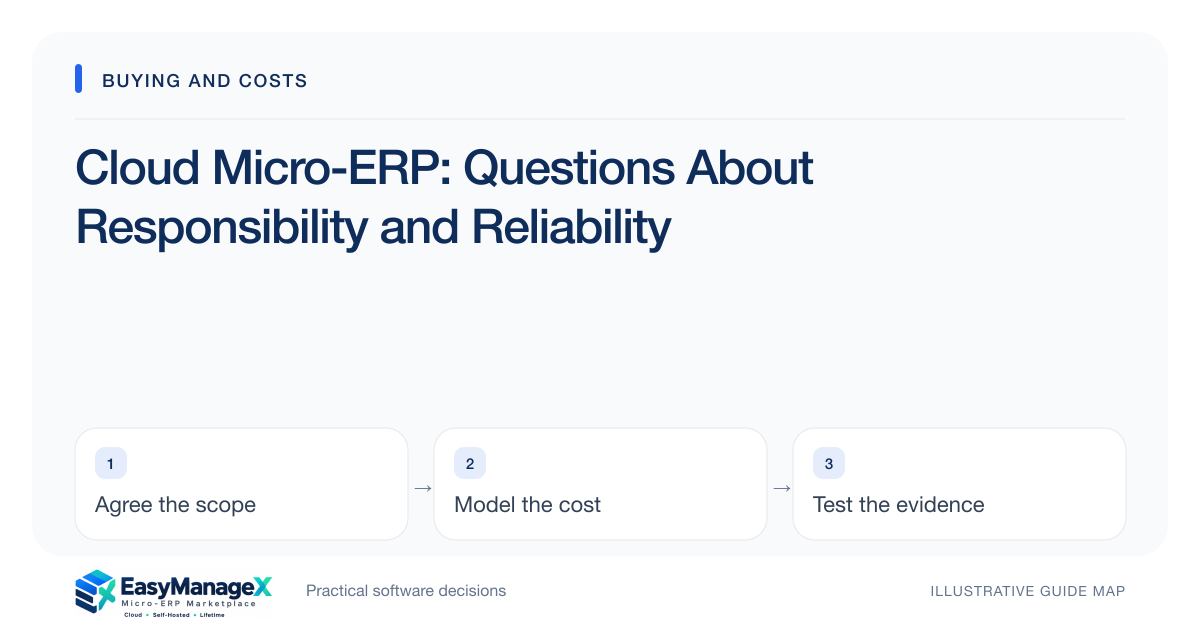
Cloud hosting changes where software runs, but it does not remove the buyer’s responsibility for access, data quality and continuity planning. Ask who operates infrastructure, restores data, handles incidents and supports users. Verify those answers against the actual service offering and test your own workflows under realistic connectivity conditions.
- Write a responsibility map rather than assuming hosting covers everything.
- Test connectivity interruptions in the workflow that matters.
- Ask for recovery and export evidence before committing.
Identify the actual service model
Cloud is a broad label. Establish whether you receive a managed application, a hosted server you administer, or infrastructure requiring your own technical team. Service-model labels help frame questions, but the actual agreement determines who maintains each component of this service.
Ask for the application operator, hosting provider and support contact separately where they differ. A reseller may handle commercial enquiries while another team restores data. The relationship is workable only when ownership and escalation paths are clear enough to use during an operational problem.
Map account responsibilities
The customer usually still decides who joins, what they can do and when access ends. Confirm whether individual accounts, administrative roles and account recovery meet your needs. Request a demonstration of an employee departure rather than accepting a general assurance about security.
Include third-party accounts used for email, payments or integrations. If a connector relies on a former employee’s personal login, hosting convenience will not solve its ownership problem. Document renewal, credential rotation and emergency recovery responsibilities alongside the application’s own user-access process.
Understand continuity expectations
Ask what availability information is provided, how incidents are communicated and what service commitments apply to your purchased tier. An advertised percentage is not a complete operating plan. Identify the functions that become unavailable and how staff continue essential work while waiting for restoration.
Discuss restore scope carefully. Whole-service recovery differs from recovering one accidentally deleted record. Ask who can request a restore, how long requests take and whether restored data could overwrite later work. Evaluate the demonstrated process against your business tolerance rather than an assumed standard.
Test an illustrative connection failure
Illustrative scenario: a small retailer uses hosted stock lookup and billing while its broadband connection briefly fails. During the trial, staff record what happens to an unfinished sale, whether an acknowledgement was received and how they reconcile the sale after reconnecting.
The test does not presume offline selling exists. If it does not, decide whether a controlled manual fallback is acceptable, a second connection is needed or this workflow requires a different design. Include busy-hour performance and device changes because a quiet office demo may miss shop-floor constraints.
Check location and export questions
Ask where business data and recovery copies are handled, which organizations can access them and what documentation supports the answers. Route jurisdiction-specific obligations to the appropriate adviser. Do not infer legal suitability from a server-region dropdown or a vendor’s use of a familiar infrastructure brand.
Request a sample export of your own trial records, including attachments and relationships. Check identifiers, timestamps and status history where needed. An export button can produce a flat list that is useful for reporting but insufficient for moving your operational history to another system.
Turn answers into a decision
Record the hosting responsibilities you accept, the controls your team must operate and unresolved evidence requests. A cloud option may reduce infrastructure work while increasing reliance on a supplier’s service processes. Judge that tradeoff against your available staff and continuity requirements.
Use EasyManageX solution categories to clarify workflow needs, then confirm capabilities and commercial terms directly for any candidate. Catalogue descriptions are illustrative. Advance only when the service design, access model and recovery expectations are understandable to both operational and technical owners.
Your working checklist
- Identify the hosting and service operator.
- Assign account administration ownership.
- Request incident communication examples.
- Test an interrupted critical transaction.
- Clarify record-level restore options.
- Inspect a sample export.
- Document your manual continuity process.
Common questions
Does cloud mean the supplier handles backups?+
Not automatically. Managed application services may include particular backup arrangements, while hosted infrastructure may leave them to the customer. Ask what is backed up, how recovery is requested and whether successful restores are tested. Compare those answers with your operational recovery needs.
Can a cloud application work without internet?+
Only if the specific application supports a defined offline workflow. Verify what data is available, what actions can be taken and how conflicts reconcile afterward. Without that evidence, plan on needing connectivity and decide how the business will handle an interruption safely.
Is hosted access suitable for multiple branches?+
It can simplify access across locations, but branch permissions, shared records, connection quality and peak usage still need testing. Use representative devices and simultaneous workflows. Confirm that each branch sees the right data and that responsibilities for cross-branch corrections are clear.
Sources and further reading
These primary references explain relevant concepts. Our scenarios and working checklists are original, illustrative guidance.
- NIST Small Business Cybersecurity Corner
Business security planning and owner responsibilities.
- AWS Well-Architected Reliability Pillar
Recovery, resilient operations and reliability decisions.
Published by EasyManageX as practical, AI-assisted guidance. Examples are illustrative. Confirm software capabilities, licence terms and project-specific requirements before committing. Read our editorial policy.