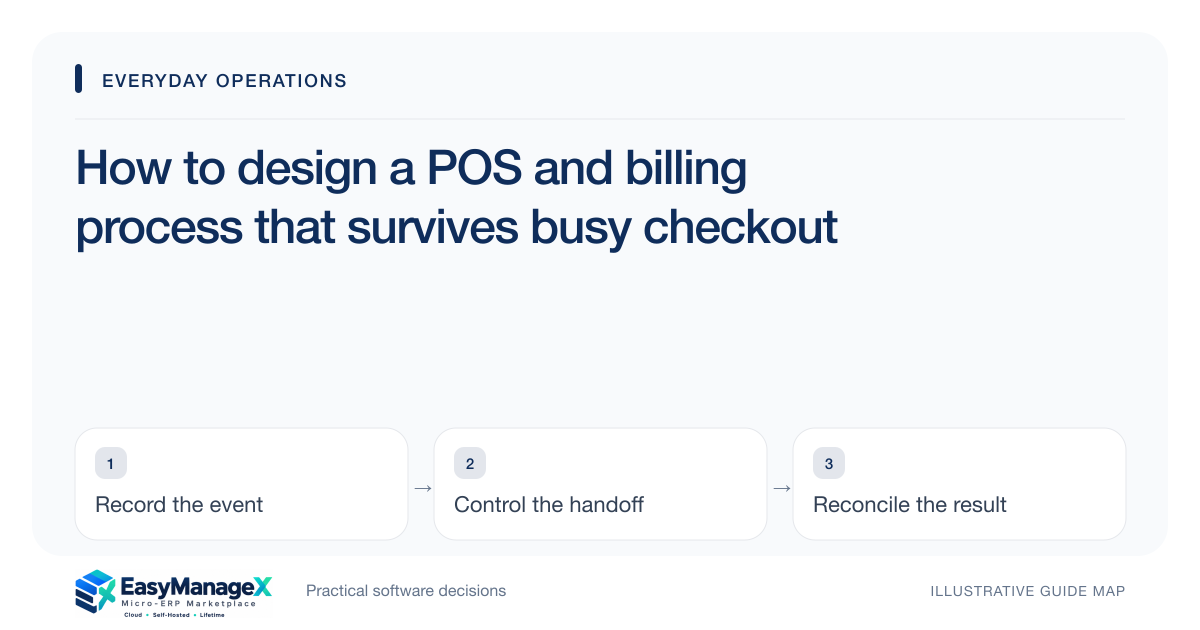
Design POS requirements around the full transaction: identify items, confirm price, apply authorised adjustments, record payment and issue a traceable bill. Include abandoned checkouts, payment uncertainty and returns from the beginning. A fast sale is useful only when another colleague can explain the transaction later without relying on the cashier’s memory.
- Keep price adjustments attributable to an authorised person.
- Distinguish a recorded sale from confirmed payment.
- Link a return to its original transaction where possible.
Prepare the item and price decision
Cashiers need an unambiguous item identifier, selling unit and current price. Similar descriptions can conceal different pack sizes or variants. Agree how barcode exceptions are handled and who can correct a catalogue record rather than letting each counter invent a local workaround.
Choose whether price updates take effect immediately or at a scheduled boundary. Preserve enough transaction detail to explain the price used at checkout. A later catalogue update should not make a historical bill impossible to understand.
Control discounts without blocking every sale
Write a discount policy that specifies eligible items, allowed adjustments and approval thresholds. Distinguish a promotional price from a discretionary cashier discount. Both affect the amount collected, but their reasons and ownership differ.
Plan the busy-period exception path. An authorised supervisor may need to approve a specific transaction without sharing their account. Evaluate how the candidate tool records the actor, reason and resulting amount; do not infer those controls from a generic discounts feature label.
Treat uncertain payment as a distinct state
A customer showing a payment screen does not necessarily resolve the store’s payment status. Define what evidence staff use to mark a payment confirmed and how they handle a pending or failed result. Keep a transaction reference for subsequent reconciliation.
Avoid retrying an uncertain payment blindly. Your procedure should explain who checks its status, how the customer is informed and when a sale can be cancelled. The goal is a consistent investigation trail when counter speed and payment certainty conflict.
Illustrative scenario: a crowded grocery counter
In an illustrative grocery store, a cashier scans a multipack under the single-unit item and notices the mismatch before completing payment. The cashier corrects the item rather than applying an unexplained discount to force the desired total.
Later, a payment remains pending. The supervisor follows the agreed verification process and records its reference before the customer leaves. At shift close, the team can distinguish the corrected basket from the unresolved payment and assign follow-up appropriately.
Connect returns to a clear decision
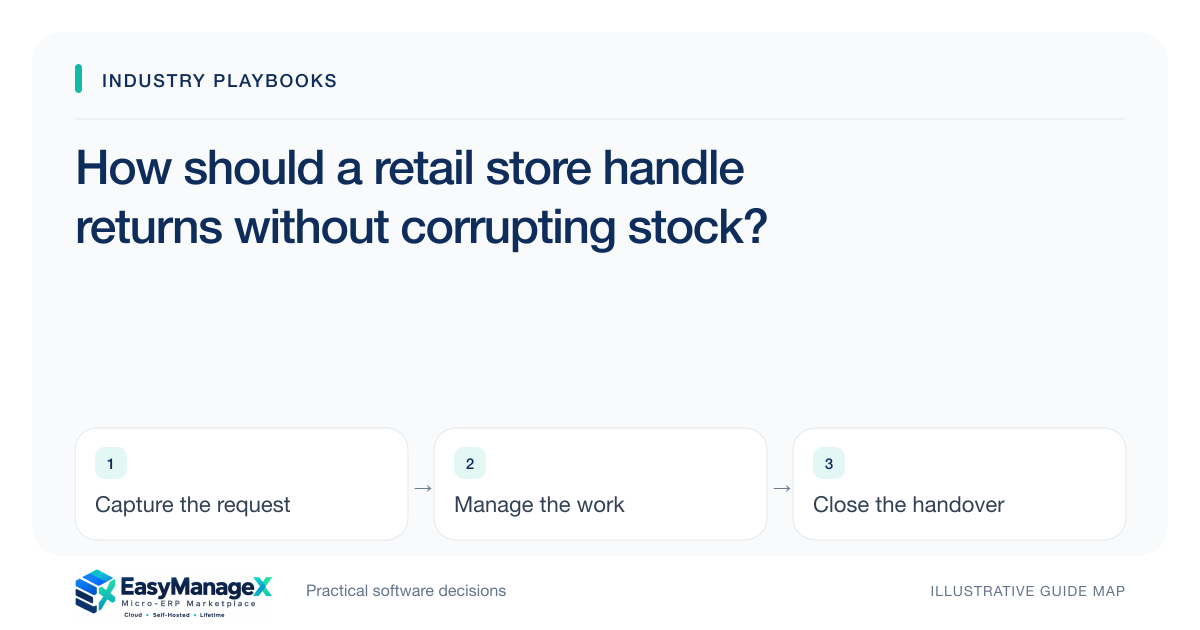
A return requires an item condition, original sale reference when available, quantity, reason and authorised disposition. Refunding money and putting goods back into sellable stock are separate actions. Damaged goods should not become available simply because a refund was approved.
Document exceptions for missing receipts or cross-channel purchases. Decide who may approve them and what evidence must remain. Keep the process understandable to staff while referring jurisdiction-specific billing and tax requirements to a qualified adviser.
Test the shift-close routine
At shift close, reconcile transactions, payment methods, refunds and unresolved cases using the same period boundary. Differences need a named reviewer and explanation. Counting a drawer without considering non-cash transactions leaves an incomplete picture of the counter’s activity.
Have cashiers and finance reviewers assess the same shift-close output from the exception demonstration. They should be able to locate transaction references and explain unresolved amounts. Confirm actual payment-provider connections separately; an attractive checkout screen does not establish successful payment verification or reconciliation.
Your working checklist
- Verify item variants and selling units.
- Document discount authority by role.
- Define pending-payment handling.
- Record references for payment investigation.
- Separate refund and stock disposition decisions.
- Reconcile each shift using a fixed boundary.
Common questions
Should cashiers be allowed to change item prices?+
Set a specific policy based on the type of exception and the amount involved. Routine price correction should identify the reason and accountable approver where required. Unrestricted price editing can obscure catalogue mistakes, while requiring approval for every minor exception may slow the counter unnecessarily.
What should happen when a payment is pending?+
Follow the payment provider’s status-verification process and retain the transaction reference. Define who investigates and how the customer receives an update. Do not mark a payment successful solely because a customer initiated it, and do not assume another attempt is safe without checking the first result.
Does a refund automatically restore inventory?+
It should depend on the returned item’s condition and your stock policy. A sealed resaleable item, a damaged item and a missing item require different dispositions. Ask a candidate system to demonstrate these outcomes so financial correction does not quietly create inaccurate sellable stock.
Sources and further reading
These primary references explain relevant concepts. Our scenarios and working checklists are original, illustrative guidance.
- IBM: What is enterprise resource planning?
Background on linked operational and finance records; the checkout recommendations are original.
- OWASP Logging Cheat Sheet
Guidance on attributable transaction events without unnecessary sensitive details.
Published by EasyManageX as practical, AI-assisted guidance. Examples are illustrative. Confirm software capabilities, licence terms and project-specific requirements before committing. Read our editorial policy.