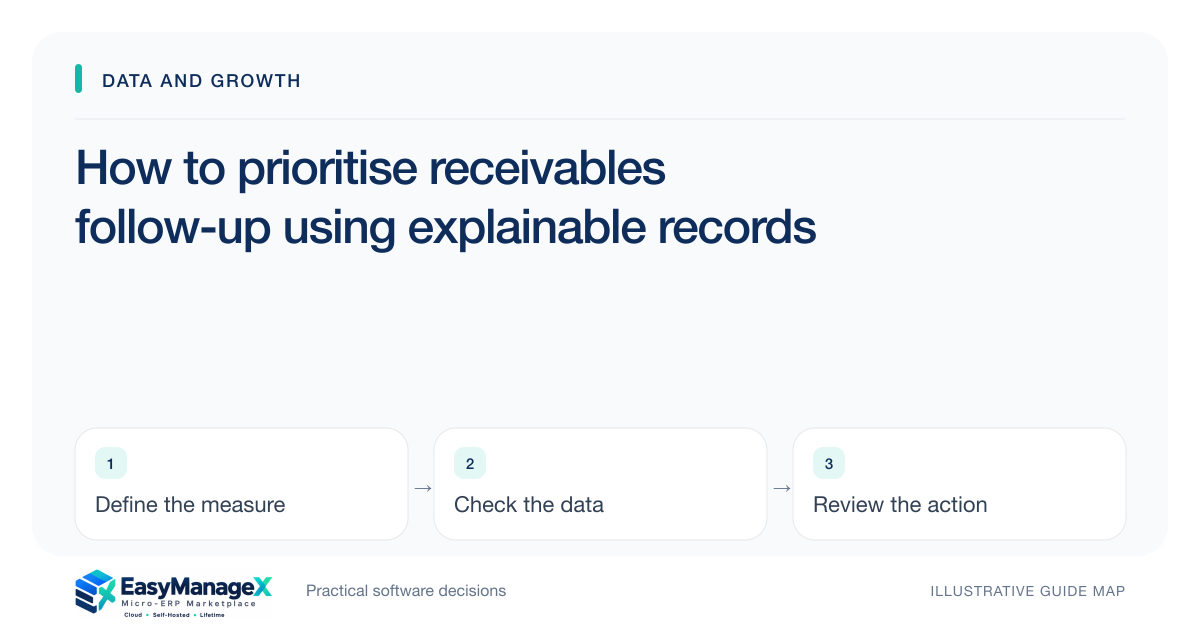
Prioritise receivables follow-up using the accepted due date, confirmed outstanding balance, dispute status and latest customer commitment. Separate missing payment evidence from genuine overdue obligations and assign a specific next action. A useful review explains why each account needs attention; it should not treat every old invoice or unanswered reminder as the same collection problem.
- Verify the outstanding balance before contacting customers.
- Separate disputes from missing payment evidence.
- Assign a specific next action and responsible owner.
Establish the balance being reviewed
Link invoices, confirmed receipts, accepted credits and reversals under the agreed finance process. A customer may have paid an amount that remains unmatched. Check relevant evidence before sending another request that incorrectly assumes no payment occurred.
Define the review cutoff and date basis. An invoice’s creation date and accepted due date answer different questions. Keep the terms or reference used for the due date visible so staff can explain why the obligation is considered outstanding at the selected boundary.
Classify the reason for follow-up
Useful categories include overdue without response, payment promised, disputed scope, missing documentation and payment awaiting matching. These need different actions and sometimes different teams. A single overdue flag can obscure the practical work required to resolve the account.
Keep the classification supported by evidence. A customer query is not necessarily a formal dispute, and a promised payment is not a confirmed receipt. Record what was communicated and what remains uncertain rather than turning convenient labels into unsupported conclusions.
Choose an explainable priority rule
Consider balance, age, customer commitment, dispute complexity and business impact according to your process. State the purpose of the priority list and who can change it. A large amount may need urgent review, but a smaller unresolved issue can also reveal a recurring process failure.
Avoid presenting priority as a prediction of recovery unless appropriate evidence supports that claim. The rule is an operational sorting decision. Staff should be able to explain why a record is reviewed first without relying on a mysterious score.
Illustrative scenario: an unmatched services payment
An illustrative consultancy finds an invoice in its overdue list. The customer has sent a payment reference, but the receipt was allocated to another engagement. Finance investigates the reference and corrects the allocation through its accepted process before further follow-up.
Another invoice remains disputed because the delivery acceptance record is missing. The project owner supplies the relevant evidence while finance coordinates the review. Repeated generic reminders would not resolve either case and could damage the conversation by ignoring the actual blocker.
Record commitments and escalation decisions
A follow-up record should contain the contact outcome, agreed next action, owner and date. If the customer promises payment, retain the stated date and verify the result afterward. Do not move an invoice into paid status solely because a promise was made.
Define escalation under the organisation’s reviewed policy and appropriate professional guidance. Commercial, legal and relationship considerations may matter. This article does not prescribe debt-collection practices or determine legal entitlement; it recommends clear evidence and responsibility for the operational review.
Review causes and reporting boundaries
Use recurring blockers to improve invoicing and delivery handoffs. Missing purchase references or unclear acceptance can be addressed earlier in the process. Keep resolved and unresolved outcomes distinct, and explain late corrections when reviewing period totals.
Review sample records with finance and the teams responsible for delivery evidence. They should explain the actual balance, blocker and next action from linked references. Banking connections and automated collection need separate verification; appropriate professional guidance governs consequential accounting, contractual or legal treatment beyond the operational list.
Your working checklist
- Set the review cutoff and due-date basis.
- Verify balances against confirmed receipts.
- Classify disputes and unmatched payments.
- Write an explainable priority rule.
- Record dated customer commitments.
- Assign blocker resolution and escalation owners.
Common questions
Should every old invoice receive the same reminder?+
No. Check whether it is genuinely overdue under its accepted terms, disputed, partly settled or awaiting payment matching. Different reasons need different actions. A generic reminder can be unhelpful when the customer already supplied evidence or the business still owes documentation needed to resolve the account.
Can a promised payment reduce the outstanding balance?+
A promise is useful follow-up context, but it is not evidence that money was received. Keep the commitment and its date separate from confirmed receipt under your finance process. Review the outcome afterward so staff can act on an unmet commitment without misrepresenting the current balance.
How should receivables priorities be chosen?+
Use a documented rule suited to the review purpose, considering relevant balance, timing, commitments and blockers. Keep exceptions attributable and avoid unsupported recovery predictions. The priority list should help staff choose an action and owner, while professional guidance governs consequential accounting, contractual or legal decisions.
Sources and further reading
These primary references explain relevant concepts. Our scenarios and working checklists are original, illustrative guidance.
- IBM: What is enterprise resource planning?
Background on linked finance, customer and operational records.
- ERPNext documentation: Lead
Further reading on accountable follow-up records and relationship context.
Published by EasyManageX as practical, AI-assisted guidance. Examples are illustrative. Confirm software capabilities, licence terms and project-specific requirements before committing. Read our editorial policy.