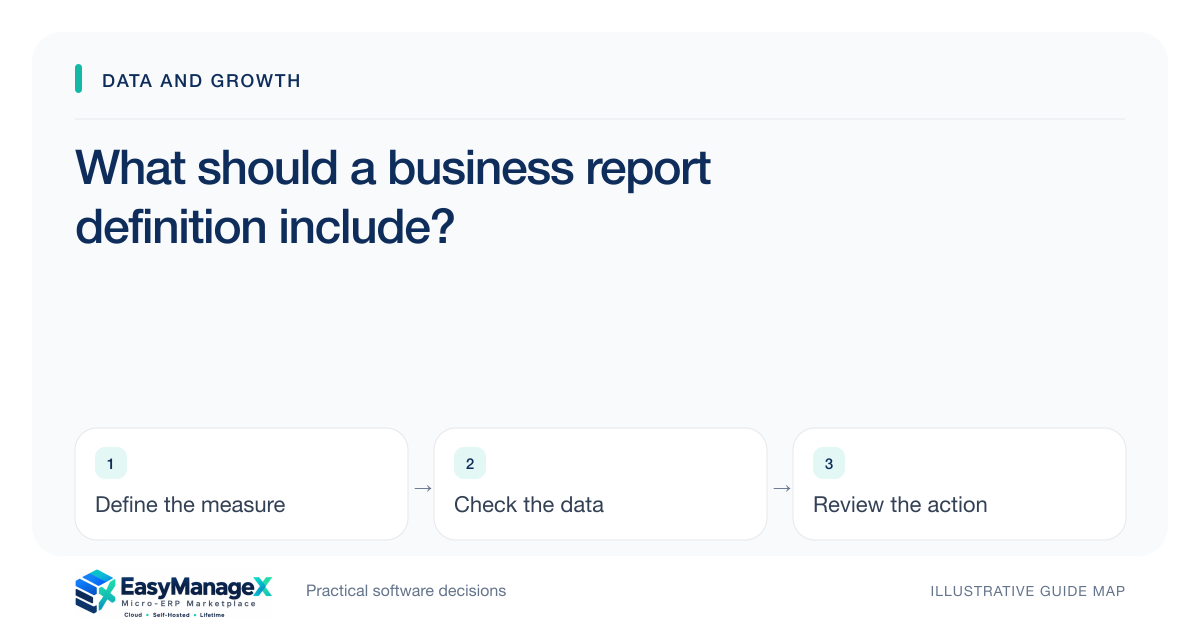
A report definition should identify its decision purpose, included records, event or date basis, calculation, exclusions, freshness and accountable owner. Add examples that clarify edge cases and preserve changes. The definition is complete when another person can reproduce the result from the same records and explain why a disputed row is included or excluded.
- Define the event and population behind each number.
- Include examples for disputed boundary cases.
- Version changes that affect historical comparison.
Write the question the report answers
Begin with a specific question such as which accepted orders remain undelivered after their commitment date. This is more useful than a report title like performance overview. The question helps decide which records and calculations are necessary.
Name the users and action owner. A finance reviewer and warehouse supervisor may need different detail even when they examine related transactions. Clarify the report’s intended decision so readers do not extend its meaning beyond the evidence it contains.
Define the event and date basis
Specify whether a record is selected by creation, approval, dispatch, delivery or another event. Choose the timezone or business-day boundary where it affects the result. A record can legitimately belong to different periods depending on the report’s question.
Document how amendments and reversals affect selection. An order created in one period and cancelled in another needs an explicit treatment. Otherwise staff may disagree because one report reflects original events while another reflects the latest record state.
State populations, units and exclusions
List included branches, statuses, item groups or transaction classes and explain exclusions. Identify the unit of analysis: order, order line, shipment, person or event. Counting shipment rows as orders can inflate a measure when one order has several deliveries.
Write calculations with enough detail to reproduce them. Include denominator handling and missing values. A percentage without an explicit population or a sum combining incompatible units can look plausible while answering no consistent operational question.
Illustrative scenario: overdue invoice definitions
An illustrative services business has two overdue invoice reports. One includes disputed invoices and uses invoice due dates; the other excludes disputes and filters by creation month. Their totals differ because the underlying questions differ, not necessarily because either calculation is broken.
The team publishes separate definitions and labels the review scope. It also creates a shared definition for the management meeting. Sample invoices with partial payment, dispute and reversal clarify exactly how each measure treats those cases.
Specify freshness and correction behaviour
Record when inputs were last refreshed and whether the report is a live view or a fixed snapshot. State how late records and corrected transactions affect previous periods. Readers should understand whether rerunning a historical report may legitimately change its result.
For consequential reviews, preserve the report snapshot or underlying version needed to explain the decision. The right method depends on volume and systems, but a current dashboard alone may not show the information that managers saw during a past review.
Assign maintenance and validation ownership
Name the owner who approves definition changes and resolves disputed rows. Test the measure using a small representative dataset before releasing it. Include edge cases rather than checking only ordinary records that every interpretation handles the same way.
Give another analyst a small dataset and the written definition, then compare their result with the intended measure. Resolve disagreements at the definition or data level. Candidate reporting tools should preserve the documented filters and identifiers so reproducibility does not depend on one person remembering hidden dashboard settings.
Your working checklist
- Write the report decision question.
- Define event and date basis.
- Specify population and unit of analysis.
- Document calculation and missing values.
- Add boundary-case examples.
- Assign definition change ownership.
Common questions
Why does a report need a unit of analysis?+
It tells readers what one counted row represents. Orders, order lines and shipments describe different populations, and one order may create several rows in another population. Naming the unit prevents inflated counts and helps reviewers understand how grouping or joining records affects the reported result.
Should a historical report ever change?+
It can change when late or corrected records are included under the documented rules. State whether the report is a live reconstruction or a preserved snapshot. Both can serve useful purposes, but readers need to know which view they are seeing before comparing it with a previous review.
Who should approve a metric definition change?+
Assign a business owner who understands the decision and consult the people responsible for the underlying data. Technical implementation and business meaning both matter. Record the reason, effective boundary and comparison implications so a new calculation does not silently rewrite the interpretation of previous periods.
Sources and further reading
These primary references explain relevant concepts. Our scenarios and working checklists are original, illustrative guidance.
- IBM: What is enterprise resource planning?
Background on shared business data used across operational reports.
- OWASP Logging Cheat Sheet
Guidance relevant to evidence and event context behind measures.
Published by EasyManageX as practical, AI-assisted guidance. Examples are illustrative. Confirm software capabilities, licence terms and project-specific requirements before committing. Read our editorial policy.